
Key takeaways
- High-frequency trading is automated trading with very short holding periods, high message rates and latency-sensitive infrastructure such as colocation and FPGAs.
- Most HFT revenue comes from market making; latency arbitrage, statistical arbitrage and event-driven strategies make up the rest.
- HFT firms initiate a large share of trading volume — estimates range from 10–40% in equities and 10–15% in FX and commodities — and provide much of the liquidity in modern markets.
- Academic evidence links HFT to tighter spreads and faster price discovery in normal conditions, but also to liquidity withdrawal and a costly speed race in stress.
- Profits are concentrated: 2025 brought record trading revenues for the largest electronic market makers, while smaller firms face rising costs.
- Regulation focuses on controls rather than bans: MiFID II defines HFT and requires testing and kill switches; US rules govern market access, systems and registration.
What is high-frequency trading?
High-frequency trading (HFT) is automated trading that uses very fast infrastructure to trade frequently, hold positions for seconds or less and finish the day close to flat. HFT firms profit from tiny edges repeated millions of times, which requires colocation, low-latency networks, specialised hardware and rigorous risk control.
There is no single legal definition, but common features are:
- Speed: reaction times measured in microseconds or nanoseconds.
- Short holding periods: positions held for milliseconds to minutes.
- High message rates: many orders, modifications and cancellations per trade.
- Low inventory: little or no overnight risk.
- Proprietary capital: most HFT firms trade their own money.
MiFID II gives the most formal definition: algorithmic trading using infrastructure designed to minimise latency, automated order decisions and high intraday message rates — at least two messages per second in a single instrument or four per second across all instruments on a venue.
HFT versus algorithmic and quantitative trading
The three terms are often used interchangeably, but they describe different things. Every HFT firm trades algorithmically, yet most algorithmic trading is not high-frequency.
| Algorithmic trading | Quantitative investing | High-frequency trading | |
|---|---|---|---|
| Core idea | A computer decides timing, price or size | Statistical models choose positions | Speed-dependent automated strategies |
| Holding period | Any (often hours for execution algos) | Days to months | Milliseconds to minutes |
| Typical user | Asset managers, brokers | Quant hedge funds | Proprietary trading firms, market makers |
| Latency matters? | Somewhat | Rarely | Critically |
| Main cost | Market impact | Research, data | Technology, colocation, data |
A pension fund buying a million shares through a VWAP algorithm is trading algorithmically. A quant fund rebalancing a factor portfolio each week is trading quantitatively. Only the firm quoting that stock thousands of times a second, and adjusting within microseconds of every trade, is doing HFT.
A short history of high-frequency trading
HFT grew out of three changes: electronic order books replacing trading floors, smaller tick sizes after US decimalisation in 2001, and rules that encouraged competition between venues — Regulation NMS in the US and MiFID in Europe. Together they created many fast, fragmented electronic markets where being first consistently paid.
| Year | Event | Why it mattered |
|---|---|---|
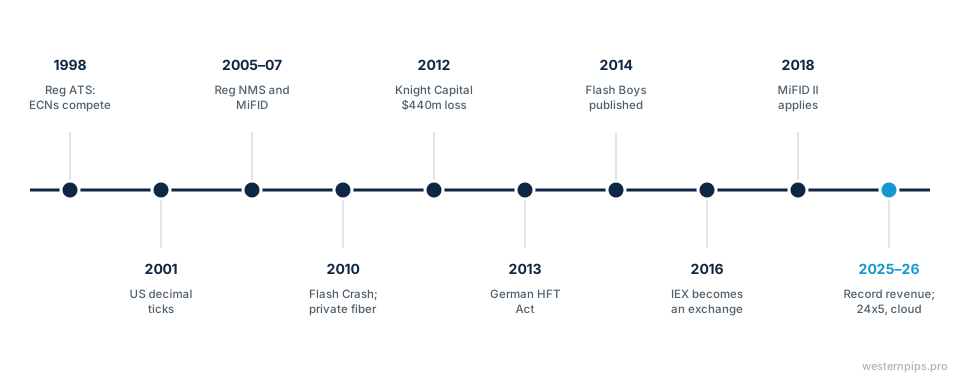
| 1998 | SEC Regulation ATS | Electronic communication networks could compete with exchanges |
| 2001 | US decimalisation | Ticks fell from 1/16 of a dollar to one cent, shrinking spreads and rewarding automation |
| 2005–2007 | Reg NMS adopted and implemented; MiFID takes effect in Europe | Fragmentation across many venues created cross-venue arbitrage |
| 2010 | Flash Crash on 6 May; dedicated Chicago–New Jersey fiber | Public scrutiny of HFT; the speed race moved to private networks |
| 2012 | Knight Capital software failure | A $440 million loss in under an hour made pre-trade controls a priority |
| 2013 | German High-Frequency Trading Act | First licensing regime aimed specifically at HFT |
| 2014 | Flash Boys published | Speed advantages became a mainstream political issue |
| 2016 | IEX approved as a US exchange | A 350-microsecond “speed bump” entered the national market system |
| 2018 | MiFID II applies | Legal definition of HFT, algorithm testing, clock synchronisation |
| 2025–2026 | Record revenues; 24x5 equities and exchange cloud migration | Scale, breadth and new trading hours define the next phase |
The early 2010s were the peak of pure speed competition. As latency differences between the fastest firms shrank to nanoseconds, the advantage moved toward breadth across asset classes, balance sheet and pricing models — which is why today’s leaders look more like diversified trading houses than the small speed shops of 2008.
Figure 1: Milestones in the history of HFT
Core HFT strategies
Most HFT revenue comes from market making — continuously quoting both sides and earning the spread. The other main strategies are latency arbitrage between venues, statistical arbitrage between related instruments, event-driven trading on news and data releases, and rebate-driven strategies.
| Strategy | How it earns | Key requirement |
|---|---|---|
| Market making | Spread and rebates | Pricing models, inventory control |
| Latency arbitrage | Trading against stale quotes | Fastest networks and hardware |
| Statistical arbitrage | Short-term mispricing between related assets | Research, low-latency execution |
| Event-driven | Reacting first to news or data | Machine-readable feeds, speed |
| Rebate capture | Exchange incentives for liquidity | Fee optimisation, queue position |
In practice, large firms blend these: a market maker uses statistical signals to skew quotes and arbitrage logic to hedge across venues.
Market making: a worked example
Suppose a stock is quoted at $50.00 bid and $50.01 offer. An HFT market maker posts 500 shares on each side. Over a minute, it buys 500 shares from a seller at $50.00 and sells 500 to a buyer at $50.01, earning $5 of spread. If the venue pays a liquidity rebate of $0.0020 per share, it earns another $2 on 1,000 shares. Repeat that across thousands of symbols and millions of trades a day, and small edges become large revenues.
The risk is in the gaps. If the price drops to $49.98 before the firm can sell its 500 shares, a $10 loss wipes out two round trips. That is why market makers obsess over adverse selection — trading against someone who knows the price is about to move — and why they skew quotes away from the side where they already hold inventory. For the theory behind this, see our guide to market microstructure.
Arbitrage and event-driven strategies
Latency arbitrage buys or sells against quotes that have not yet updated to a price change elsewhere — for example, when S&P 500 futures in Aurora tick up before the cash ETF in New Jersey reflects it. Statistical arbitrage at high frequency trades short-lived divergences between related instruments: an ETF and its constituents, two share classes, or a futures contract and its calendar spread. Event-driven strategies parse machine-readable economic releases and news within microseconds of publication. All three depend on direct market data feeds and the fastest possible links between venues.
The infrastructure behind HFT
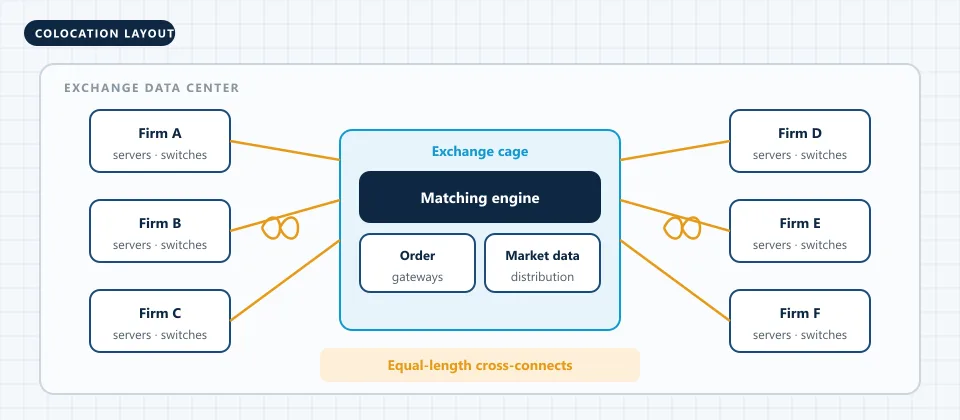
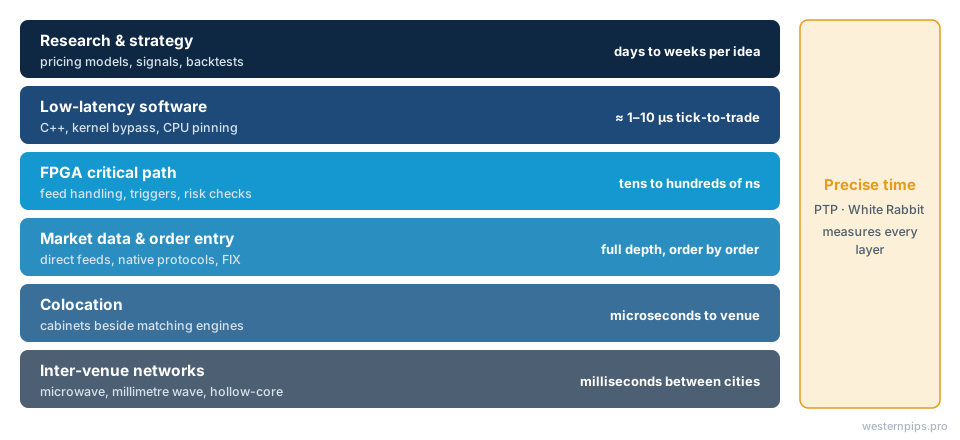
HFT runs on colocated servers inside exchange data centers, private microwave and fiber networks between venues, kernel-bypass software and FPGAs for the critical path, and precise time synchronisation to measure everything. Each layer is engineered to remove microseconds — or nanoseconds — of delay.
- Colocation: servers next to matching engines.
- Low-latency networks: microwave, millimetre wave and hollow-core fiber between data centers.
- FPGAs: hardware logic for feed handling, risk checks and order entry.
- Market data: direct order-by-order feeds rather than consolidated data.
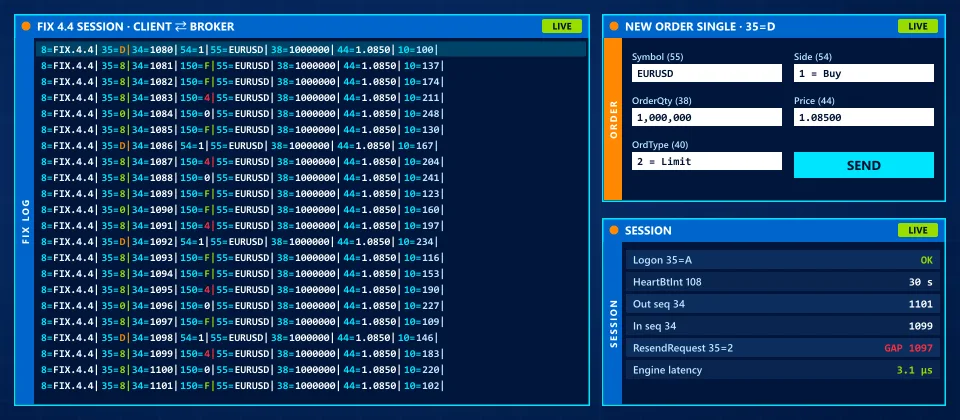
- Order entry protocols: binary native exchange protocols on the fastest path, FIX for less latency-critical flows.
- Precise time: PTP and White Rabbit for regulation and measurement.
The key measure is tick-to-trade: the time from a market data packet arriving at the network card to an order leaving it. Optimised software on a tuned server with kernel bypass typically achieves single-digit microseconds; FPGA-based systems reach well below one microsecond, and the fastest published benchmarks are in the tens of nanoseconds. Beyond that point, the bottleneck shifts to physics — cable lengths inside the data center and the speed of light between venues.
Figure 2: The HFT technology stack
Risk management and controls inside an HFT firm
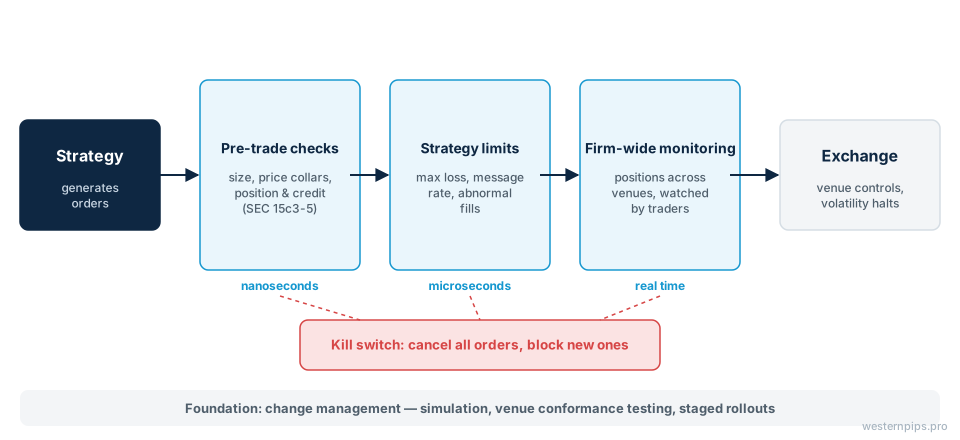
Because HFT systems send thousands of orders a second, a bug can cause large losses in seconds. Firms layer controls: pre-trade checks on price, size and position in the critical path, real-time P&L and exposure limits, kill switches that cancel all orders, and strict testing before any code reaches production.
Typical control layers, from fastest to slowest:
- Pre-trade risk checks in hardware or software — maximum order size, price collars around the market, position and credit limits. SEC Rule 15c3-5 requires broker-dealers with market access to have these.
- Strategy-level limits — maximum loss per strategy, maximum message rate, automatic shutdown on abnormal fills.
- Firm-wide monitoring — aggregated positions across venues and asset classes, watched by traders in real time.
- Kill switches — one action that cancels every resting order and blocks new ones, required for algorithmic traders under MiFID II RTS 6.
- Change management — simulation, conformance testing with venues and staged rollouts.
Knight Capital’s 2012 incident remains the reference case: dormant code was accidentally reactivated on one server, and the firm sent millions of unintended orders before staff could stop it. The lesson that controls must sit outside the strategy code itself is now built into regulation.
Figure 3: Layers of risk control
How big is HFT?
HFT’s share depends on the market and the definition. Commonly cited research puts it at 10–40% of equity trading volume and 10–15% in FX and commodities, while its share of quotes and orders is much higher. FCA research found latency races alone covered about 20% of UK equity volume.
Industry economics have also shifted. Academic estimates suggested US equity HFT profits fell from around $5 billion in 2009 to about $1.25 billion in 2012 as competition and costs rose. More recently, the largest electronic market makers have grown into some of the most profitable trading firms in the world: reports based on people familiar with the figures put 2025 net trading revenue at a record $39.6 billion for the largest firm and around $12 billion each for two other leaders.
The pattern is consolidation: a few firms with scale across asset classes capture most profits, while smaller players face rising technology, data and colocation costs. Research by Baron, Brogaard, Hagströmer and Kirilenko found the same within HFT itself — returns concentrate among the fastest firms, and new entrants tend to earn less.
HFT across asset classes
| Market | Role of HFT | Distinctive features |
|---|---|---|
| US and European equities | Major liquidity providers on lit venues; wholesalers for retail flow | Fragmentation, maker-taker fees, tick-size rules |
| Futures | Market making and cross-product arbitrage on central order books | Single venue per contract; futures often lead cash markets |
| US Treasuries | Principal trading firms are major participants on interdealer platforms | Very liquid, but stress episodes such as the October 2014 flash rally |
| Spot FX | Non-bank liquidity providers stream prices to banks, brokers and ECNs | OTC structure, last look — see our FX liquidity guide |
| Options | Market making across thousands of strikes and expiries | Volatility models, short-dated options growth |
| Crypto | Market making on centralised exchanges, basis and funding rate arbitrage | 24/7 trading, exchange-specific risk |
How HFT firms are organised
HFT firms are typically small relative to their trading volume. Teams of quantitative researchers, software and hardware engineers and traders share code, infrastructure and risk systems. Technology and research are the main costs; capital requirements are modest compared with traditional funds because positions turn over constantly.
Typical roles:
- Quant researchers who build pricing and signal models.
- Software engineers writing low-latency C++ and infrastructure.
- FPGA and network engineers optimising the critical path.
- Traders who supervise strategies, manage risk and handle incidents.
- Risk and compliance teams monitoring limits, controls and regulation.
Two organisational models dominate. Some firms run a single shared platform, where all strategies use common infrastructure and profits are pooled. Others run independent teams that compete for capital and share only core infrastructure. Both rely on fast research cycles: an idea can go from backtest to production in days, and strategies decay as competitors catch up.
What the evidence says about HFT and market quality
Most academic studies find that HFT and algorithmic trading narrowed spreads and sped up price discovery in normal conditions. Research also shows HFT can amplify volatility in stress and that the speed race imposes a measurable cost on other traders. The net effect depends on the market and the strategy.
Key findings from widely cited research:
- Liquidity: Hendershott, Jones and Menkveld (2011) found that the growth of algorithmic trading on the NYSE narrowed spreads and reduced adverse selection.
- Price discovery: Brogaard, Hendershott and Riordan (2014) found that HFTs on balance trade in the direction of permanent price changes, helping prices become efficient faster.
- New market makers: Menkveld (2013) showed how a single HFT market maker supported a new European venue’s growth by quoting continuously across markets.
- Stress: Kirilenko, Kyle, Samadi and Tuzun (2017) concluded that HFTs did not trigger the 2010 Flash Crash but their trading exacerbated volatility as they reduced inventory.
- Arms race: Budish, Cramton and Shim (2015) argued that continuous limit order books create mechanical arbitrage opportunities, so speed investment is a cost that liquidity providers pass on through wider spreads.
- Size of the tax: FCA research estimated that latency arbitrage costs about 0.42 basis points of traded value — a small number per trade but around $5 billion a year across global equities.
Benefits and criticism
Supporters credit HFT with narrower spreads, deeper continuous liquidity and lower trading costs for most investors. Critics argue that speed races tax other participants, that HFT liquidity can vanish in stress, and that the arms race wastes resources. The evidence supports parts of both views.
Arguments for:
- Tighter spreads and lower explicit trading costs since electronification.
- Continuous two-sided quotes across thousands of instruments.
- Faster price alignment across venues and asset classes.
Arguments against:
- Latency arbitrage acts as a tax on liquidity — FCA estimates put it at about 0.42 basis points of volume.
- Liquidity can withdraw in stress, as in the 2010 Flash Crash.
- Resources spent on microseconds have limited social value.
- Abusive practices such as spoofing and layering have been pursued by regulators.
Popular accounts such as Michael Lewis’s Flash Boys (2014) shaped public perception; the academic literature is more nuanced. For institutional desks, the practical question is not whether HFT is good or bad but how to trade alongside it: using order types, venues and algorithms that reduce information leakage while still accessing HFT-provided liquidity.
Market design responses: speed bumps and batch auctions
Some venues redesign trading to reduce the value of pure speed. Speed bumps delay incoming orders by a fixed interval so quotes can update first; periodic and frequent batch auctions match orders at discrete moments instead of continuously. These designs shift competition from speed toward price.
| Design | How it works | Where it is used |
|---|---|---|
| Symmetric speed bump | All orders delayed by the same fixed time | IEX (350 microseconds, created with coiled fiber) |
| Asymmetric speed bump | Only liquidity-taking orders are delayed, protecting resting quotes | Selected equity, FX and options venues |
| Periodic auctions | Orders collected for a short random interval, then matched at one price | European equity venues, especially after MiFID II dark-pool caps |
| Frequent batch auctions | Proposed by Budish, Cramton and Shim: auctions every fraction of a second | Academic proposal; partial adoption |
| Randomised delays | Small random delays or batching of incoming orders | Some FX ECNs |
These mechanisms do not eliminate HFT. They change which strategies pay: market making becomes safer, while pure latency arbitrage loses value. Firms then compete on pricing models and on quoting more instruments.
How HFT is regulated
Regulators control HFT rather than ban it. In the EU, MiFID II defines HFT, requires authorisation, algorithm testing, kill switches and record keeping, and limits order-to-trade ratios. In the US, rules govern market access risk controls, exchange systems resilience and registration, alongside anti-manipulation law.
| Jurisdiction | Key rules |
|---|---|
| European Union | MiFID II HFT definition; RTS 6 algorithmic controls; RTS 25 clock accuracy; order-to-trade limits |
| United States | SEC Rule 15c3-5 (market access); Reg SCI (systems); FINRA registration; anti-spoofing rules; Consolidated Audit Trail reporting |
| Germany | High-Frequency Trading Act (2013): licensing and algorithm flagging |
| Individual countries | Italy and France apply financial transaction taxes with HFT-specific elements |
Market-wide safeguards also changed after 2010: US single-stock limit up-limit down bands, revised market-wide circuit breakers and stricter obligations for registered market makers. In Europe, venues must have volatility interruptions and the ability to cancel erroneous trades. Clock-synchronisation rules such as RTS 25 make it possible to reconstruct events afterwards — see our PTP guide.
Can individuals do high-frequency trading?
Not competitively. Institutional HFT needs exchange membership or sponsored access, colocation, direct feeds, specialised hardware and engineering teams — costs that run far beyond what retail trading can justify. Individuals can automate strategies, but at retail latencies they cannot win races against firms measured in nanoseconds.
This question comes up constantly on trader forums, and the honest answer is about economics rather than skill. A competitive setup on a single venue requires colocated servers, cross-connects, direct market data licences, exchange connectivity and, usually, a broker-dealer or clearing relationship that allows direct market access. Before hiring anyone, those costs alone can easily reach tens of thousands of dollars a month.
What individuals can realistically do:
- Medium-frequency algorithmic trading with holding periods of minutes to days, where latency matters far less.
- Learning the field by reconstructing order books from public sample data and building simulators.
- Careers at trading firms, which hire software engineers, FPGA engineers and quantitative researchers.
Retail traders should also understand that their orders often interact with HFT firms — through wholesalers in US equities via payment for order flow, or through liquidity providers behind their broker in FX and crypto.
The future of HFT
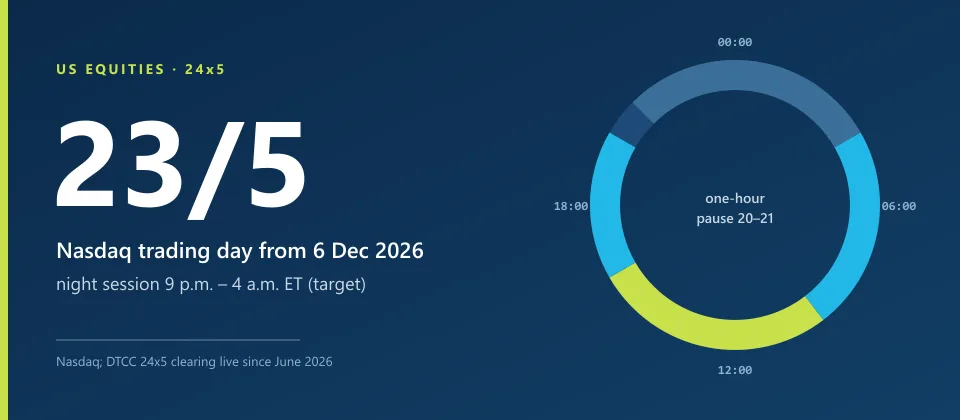
HFT is expanding into new markets and new technology: 24x5 US equities, crypto and on-chain venues, prediction markets, exchange cloud migration and AI-assisted research. Speed remains essential, but the edge is shifting toward breadth, data and risk management across many asset classes.
Trends to watch:
- 24x5 equities: new overnight sessions to quote — see our 24-hour trading analysis.
- Crypto and DeFi: CEX market making, on-chain order books and MEV.
- Cloud exchanges: CME’s move to Google Cloud, with Aurora colocation targeted for late 2027, changes the colocation model.
- Market design: speed bumps and batch auctions reshape where speed pays.
- Market structure reform: US tick-size and access-fee changes due in November 2026, and the EU consolidated tape live since September 2026.
- AI: machine learning in research and monitoring, with foundation models as a new tool — but not on the nanosecond critical path.
Frequently asked questions
What is high-frequency trading?
High-frequency trading (HFT) is a form of algorithmic trading that uses fast infrastructure and automated strategies to trade very frequently, hold positions for seconds or less and end the day close to flat. It relies on colocation, fast networks and specialised hardware.
Is high-frequency trading legal?
Yes. HFT is legal in all major markets. Specific abusive practices — spoofing, layering, quote stuffing, front-running — are illegal, and HFT firms must comply with rules on market access, system controls, testing and record keeping.
How do HFT firms make money?
Mostly by market making: quoting both sides and earning the spread and rebates on very large volume. Other sources include latency and statistical arbitrage and reacting quickly to news and events. Profit per trade is tiny; scale and risk control make it work.
What is the difference between HFT and algorithmic trading?
Algorithmic trading is any trading where a computer decides order timing, price or size, including slow execution algorithms used by pension funds. HFT is the subset that depends on speed: very short holding periods, high message rates and infrastructure built to minimise latency.
What share of trading is high-frequency?
Estimates vary by market and definition. Commonly cited research puts HFT at 10–40% of equity trading volume and 10–15% of volume in FX and commodities, and HFT firms account for a much larger share of quotes and orders.
Can individuals do high-frequency trading?
Not in the institutional sense. Competitive HFT requires exchange membership or sponsored access, colocation, direct market data and engineering teams, which cost far more than a retail account can justify. Individuals can trade algorithmically, but at retail latencies they are on the other side of HFT, not competing with it.
Does HFT cause flash crashes?
HFT did not cause the 2010 Flash Crash on its own, but the episode showed that fast liquidity providers can withdraw in stress, amplifying moves. Circuit breakers, limit up-limit down bands and market-maker obligations were strengthened afterwards.
Sources and further reading
- High-frequency trading — Wikipedia (history, market share and enforcement references), 2026
- Quantifying the High-Frequency Trading Arms Race (OP 50) — Financial Conduct Authority, 2020
- The High-Frequency Trading Arms Race (Quarterly Journal of Economics 130(4)) — Eric Budish, Peter Cramton and John Shim, 2015
- High-Frequency Trading and Price Discovery (Review of Financial Studies 27(8)) — Jonathan Brogaard, Terrence Hendershott and Ryan Riordan, 2014
- The Flash Crash: High-Frequency Trading in an Electronic Market (Journal of Finance 72(3)) — Andrei Kirilenko, Albert Kyle, Mehrdad Samadi and Tugkan Tuzun, 2017
- Commission Delegated Regulation (EU) 2017/589 (RTS 6) on algorithmic trading — European Union, 2017
- Jane Street, Citadel Securities cement sway with trading hauls — Bloomberg Law, 2026

Svetlana Berezhnova is a co-founder of Westernpips and has been a trader since 2007. She has been with the company from its very beginning and is an expert in high-frequency trading and latency-sensitive trading software.
This article is for educational purposes and describes market structure; it is not investment, legal or tax advice. Statistics are attributed to their original sources, which should be consulted for methodology and limitations.