
Key takeaways
- Colocation means placing a firm’s trading servers in the same data center as an exchange’s matching engine, cutting network latency to microseconds.
- Exchanges must offer colocation on fair and non-discriminatory terms; many equalise cable lengths so every client has the same physical distance.
- Key facilities include Equinix NY4 (FX hub), NYSE Mahwah, Nasdaq Carteret, CME Aurora, LD4 in Slough, FR2 in Frankfurt and TY3 in Tokyo.
- Costs come from cabinets and power, cross-connects, connectivity and market data — often several times the cost of the hardware itself.
- Exchange cloud migration, led by CME and Google Cloud with Aurora colocation targeted for late 2027, is redefining what colocation means.
What is colocation in trading?
Colocation means placing your trading servers in the same data center as an exchange’s matching engine. Instead of sending orders across a city or a continent, a colocated firm connects to the exchange with a short cable, cutting network latency from milliseconds to microseconds. It is the foundation of every latency-sensitive trading business.
Every electronic venue runs its matching engine — the system that pairs buy and sell orders — on servers in a specific building. Market data originates there, and orders must arrive there. Distance therefore translates directly into delay: light in fiber covers about 200 kilometres per millisecond, so a server 100 kilometres away loses roughly a millisecond on every round trip compared with one in the same hall.
For market makers, that delay is the difference between updating a quote in time and being picked off by a faster trader. For execution desks, it affects fill rates and slippage. For brokers, it determines how quickly client orders reach liquidity.
How colocation works: cabinets, cross-connects and equal-length cabling
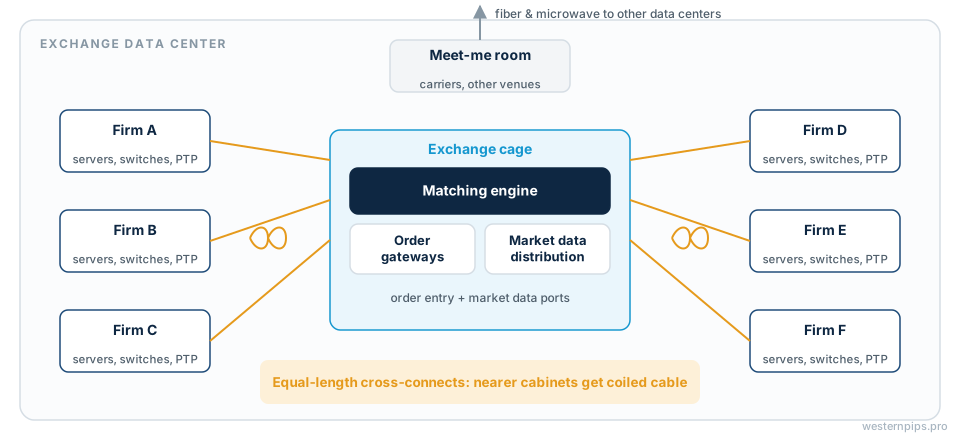
A colocated firm rents cabinet space and power inside the exchange data center, installs its servers and network equipment, and connects to the exchange through cross-connects — dedicated physical cables. Many exchanges cut every client’s cable to the same length so no one gains an advantage from being closer.
The building blocks of a colocation deployment:
- Cabinet (rack) and power: priced mainly by kilowatts of power, since cooling dense trading hardware is the data center’s biggest cost.
- Cross-connects: fiber links to the exchange’s order entry and market data networks, to carriers and to other firms in the building.
- Market data and order entry ports: separate exchange fees for feed access and gateway sessions.
- Network equipment: low-latency switches, often layer-1 devices, plus precise time-synchronisation hardware.
Equal-length cabling is a fairness measure used by several exchanges: whether a client’s cabinet is 10 metres or 100 metres from the matching engine, its cable is coiled to the same length. The edge then comes from hardware and software, not from cabinet position.
Figure 1: Inside an exchange colocation data center
The financial data centers that matter
A small number of facilities host most electronic trading. In the US, the New Jersey triangle — NYSE Mahwah, Nasdaq Carteret and Equinix NY4/NY5 in Secaucus — plus CME’s Aurora facility near Chicago. In Europe, LD4 in Slough, Basildon and FR2 in Frankfurt; in Asia, TY3 in Tokyo, plus Hong Kong and Singapore.
| Facility | Location | Main markets |
|---|---|---|
| NYSE Mahwah | New Jersey | NYSE equities and options |
| Nasdaq Carteret | New Jersey | Nasdaq equities and options |
| Equinix NY4/NY5 | Secaucus, New Jersey | FX ECNs, Cboe, options, many venues |
| CME Aurora | Illinois | CME Globex futures and options |
| Equinix LD4 | Slough, UK | European FX, equities venues |
| ICE Basildon | Essex, UK | ICE Futures Europe |
| Equinix FR2 | Frankfurt | Eurex, European venues |
| Equinix TY3 | Tokyo | Japanese venues and Asian FX |
NY4 deserves a special note: it is the centre of gravity for institutional FX, hosting multiple ECNs and liquidity providers. LD4 plays a similar role in London. For FX liquidity providers and brokers, presence in both is close to mandatory.
What colocation costs
Colocation costs combine space and power, cross-connects, network connections, exchange connectivity fees and market data licences. The hardware is often the smallest line item. A minimal presence can cost a few thousand dollars per month, while a multi-venue deployment with full market data can reach hundreds of thousands.
Typical cost drivers:
- Power and cabinet space, priced per kilowatt per month.
- Cross-connects, each billed monthly.
- Exchange connectivity — order entry sessions and port fees.
- Market data — direct-feed licences and non-display fees, often the largest recurring cost.
- Inter-site connectivity — microwave or fiber between data centers.
- Operations — remote hands, monitoring, hardware refresh.
Because exchanges sell both colocation and data, the total cost of being competitive has become a policy issue in its own right.
Rules: fair and non-discriminatory access
Regulators treat colocation as a service exchanges must offer fairly. In the EU, MiFID II’s RTS 10 requires trading venues to provide colocation on fair, non-discriminatory and transparent terms, with published pricing. US exchanges must file colocation fees with the SEC, which reviews them for fairness.
Common requirements and practices:
- Published, non-discriminatory price lists.
- Equal access to cabinets and connectivity options for all paying members.
- Latency equalisation inside the facility, such as equal-length cabling.
- Disclosure of any differences between connectivity products.
The FCA’s research on latency arbitrage races shows why these rules matter: with races measured in microseconds, small physical differences inside a building would otherwise decide outcomes.
Colocation vs proximity hosting vs cloud
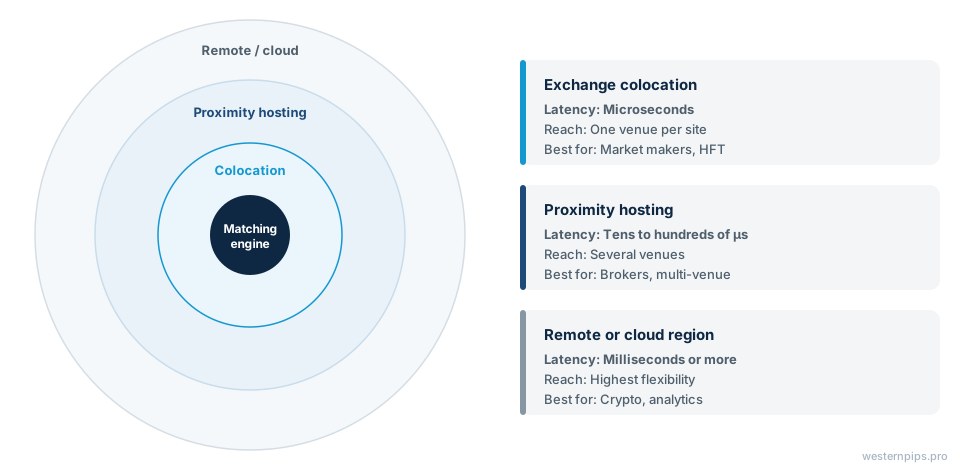
Colocation gives the lowest latency to one venue. Proximity hosting in a nearby facility is slightly slower but cheaper and better for reaching several venues. Cloud hosting suits crypto exchanges and non-latency-critical workloads — and is becoming relevant for traditional markets as exchanges move into private cloud regions.
| Model | Latency to venue | Flexibility | Best for |
|---|---|---|---|
| Exchange colocation | Lowest (microseconds) | One venue per site | Market makers, HFT |
| Proximity hosting | Low (tens to hundreds of microseconds) | Multiple venues | Brokers, multi-venue strategies |
| Trading VPS | Low to moderate | High | Smaller firms, testing |
| Public cloud region | Varies | Highest | Crypto venues, analytics |
Figure 2: Latency rings around a matching engine
Colocation in crypto markets
Most major crypto exchanges run their matching engines in public cloud regions, especially in Tokyo and other Asian regions. For crypto traders, colocation usually means deploying servers in the same cloud region and availability zone as the exchange, with some venues offering dedicated network links or physical colocation.
Cloud-hosted matching raises its own fairness questions: availability zones differ in network distance, cloud networking adds jitter and exchanges may offer premium connectivity tiers. Some venues have partnered with cloud providers to offer “cloud-native colocation” with equalised network paths.
The future: exchanges in the cloud
CME Group is moving CME Globex into a dedicated Google Cloud region. In October 2026 it said Google Cloud-managed services and colocation in Aurora would be available in late 2027, with customer testing from mid-2027. Cloud colocation could change who operates trading data centers and how latency is equalised.
Questions trading firms should ask about cloud colocation:
- How is latency measured and equalised between clients in a cloud region?
- What hardware can clients bring — FPGAs, custom NICs, precise timing?
- How are market data and order entry networks separated from general cloud traffic?
- What happens to existing cross-connects and microwave landing points?
Until those answers are clear, physical colocation in the established data centers remains the benchmark for latency-sensitive trading.
Frequently asked questions
What is colocation in trading?
Colocation is the practice of placing a trading firm’s servers in the same data center as an exchange’s matching engine. It minimises the physical distance that market data and orders must travel, reducing latency from milliseconds to microseconds.
Is colocation fair to other traders?
Regulators require exchanges to offer colocation on fair, transparent and non-discriminatory terms — any firm that pays can access it. Exchanges often equalise cable lengths inside the facility. Critics argue that the cost still gives well-capitalised firms an advantage.
How much does exchange colocation cost?
Pricing is usually based on cabinet space and power, plus monthly fees for each cross-connect and network connection. A small presence can cost thousands of dollars per month; large deployments at several venues, including market data, can run to hundreds of thousands.
What is the difference between colocation and proximity hosting?
Colocation is inside the exchange’s own facility or designated hall. Proximity hosting is in a nearby data center connected by short fiber or wireless links. It is slightly slower but often cheaper and more flexible, especially for connecting to several venues.
Do crypto exchanges offer colocation?
Most large crypto exchanges run their matching engines in public cloud regions, so “colocation” usually means deploying in the same cloud region and availability zone. A few venues offer physical colocation in traditional financial data centers.
Sources and further reading
- CME Group announces cloud migration milestones — CME Group, 2026
- Commission Delegated Regulation (EU) 2017/573 (RTS 10) on fair and non-discriminatory co-location services — European Union, 2017
- Quantifying the High-Frequency Trading Arms Race (OP 50) — Financial Conduct Authority, 2020

Svetlana Berezhnova is a co-founder of Westernpips and has been a trader since 2007. She has been with the company from its very beginning and is an expert in high-frequency trading and latency-sensitive trading software.
This article is for educational purposes and describes market structure; it is not investment, legal or tax advice. Statistics are attributed to their original sources, which should be consulted for methodology and limitations.