
Key takeaways
- US equities are moving from a 6.5-hour core session toward near-continuous 24x5 trading, driven by global and retail demand.
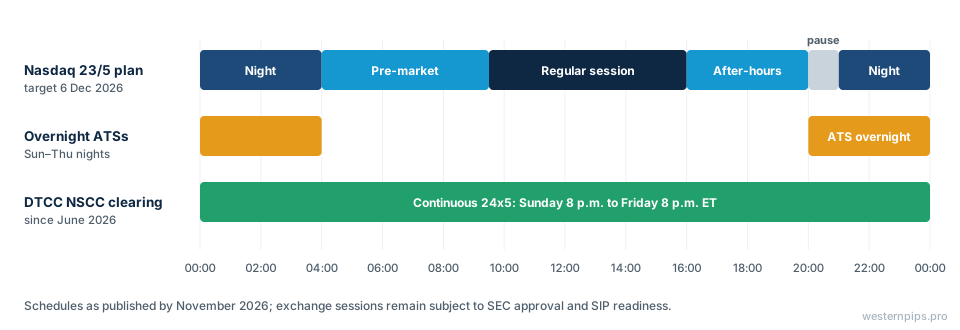
- Nasdaq has targeted Sunday 6 December 2026 for a 23/5 schedule, with a night session from 9 p.m. to 4 a.m. ET, subject to SEC and SIP readiness.
- DTCC’s NSCC moved to 24x5 clearing in June 2026; SIP extended hours are expected from late 2026 into 2027.
- Today, overnight trading mostly runs through alternative trading systems used by retail brokers, with limit orders only and price bands of around 20%.
- Overnight liquidity is thin and spreads are wide; for market makers the opportunity comes with inventory, halt and data-coverage risks.
What is 24-hour stock trading?
24-hour stock trading means being able to buy and sell shares around the clock on weekdays, not just during the 9:30 a.m.–4 p.m. ET core session. In the US the model is “24x5”: trading from Sunday evening to Friday evening. Today most overnight volume runs through alternative trading systems; exchanges are now preparing their own overnight sessions.
US equities have long had pre-market (from 4 a.m. ET) and after-hours (until 8 p.m. ET) sessions. The new step is the overnight session between 8 p.m. and 4 a.m. ET, which connects the US trading day with Asian and European hours.
Why US markets are moving to 24x5
Demand comes from global investors trading US stocks in their own time zones, a growing retail audience used to 24/7 crypto markets and brokers competing on access. Infrastructure — clearing, consolidated data and exchange systems — has been the bottleneck, and 2026 is the year that bottleneck starts to clear.
Drivers include:
- Asian demand: US large caps are widely held by investors in Asia, whose daytime is the US night.
- Event risk: earnings and macro news increasingly break outside US hours.
- Retail brokers: competition on product features, including overnight trading.
- Crypto precedent: investors accustomed to markets that never close.
The overnight landscape today: ATSs and brokers
Overnight US equity trading currently runs mainly through alternative trading systems that brokers connect to. Sessions typically run from 8 p.m. to 4 a.m. ET, Sunday to Thursday nights. Brokers generally allow only limit orders, apply price bands of around 20% from a reference price and offer from several hundred to more than 10,000 symbols.
| Feature | Typical overnight practice |
|---|---|
| Hours | About 8 p.m.–4 a.m. ET, Sunday to Thursday nights |
| Order types | Limit orders only; no stops or market orders |
| Price protection | Bands around a reference price (often ~20%) |
| Universe | From a few hundred to 10,000+ stocks and ETFs, depending on broker |
| Venue | Overnight ATSs |
Broker practice varies. Some brokers offer orders that carry across sessions automatically; others require a separate overnight order. Coverage, price bands and execution quality differ widely, which matters for anyone comparing overnight fills.
Exchange plans: Nasdaq, NYSE and 24X
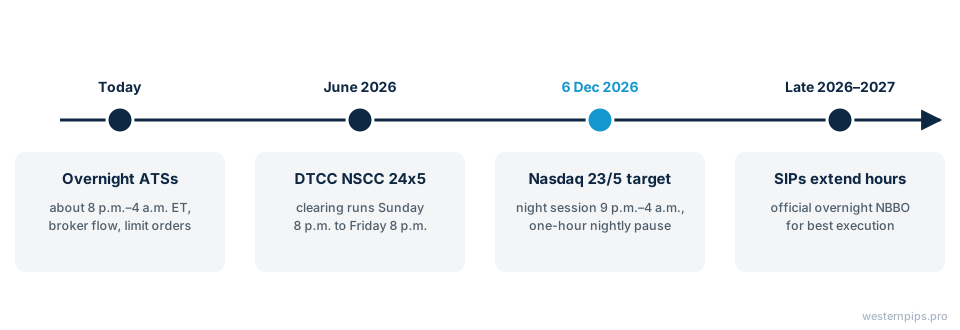
Nasdaq has targeted Sunday 6 December 2026 for a 23/5 schedule, adding a night session from 9 p.m. to 4 a.m. ET with a one-hour nightly pause, subject to SEC approval and SIP readiness. NYSE has pursued a 22-hour model for NYSE Arca, and the newer 24X National Exchange was built specifically for extended hours.
| Venue | Plan (as of November 2026) | Key dependencies |
|---|---|---|
| Nasdaq | 23/5 from 6 Dec 2026 target; night session 9 p.m.–4 a.m. ET | SEC approvals, SIP extended hours |
| NYSE Arca | 22-hour weekday trading with initial SEC approval | Data-feed and SIP upgrades |
| 24X National Exchange | Exchange designed for extended hours | SIP and clearing hours |
| Overnight ATSs | Operating today for broker flow | Broker connectivity |
Exchange-run sessions matter because they bring exchange rules, transparency and — once the SIPs extend their hours — consolidated quotes into the overnight market.
Figure 1: The US equity day under a 24x5 schedule
Infrastructure: clearing, settlement and the SIP
DTCC’s National Securities Clearing Corporation moved to a 24x5 clearing schedule in June 2026, running from Sunday 8 p.m. to Friday 8 p.m. ET. The securities information processors, which publish consolidated quotes and the NBBO, are expected to extend their hours between late 2026 and 2027.
Why each piece matters:
- Clearing (NSCC): trades must be novated and risk-managed around the clock; this went live in June 2026.
- Settlement: overnight trades settle on the correct T+1 date, which requires clear trade-date conventions.
- SIP: without consolidated overnight quotes, there is no official NBBO for best-execution and order-protection purposes.
- Market surveillance: regulators and exchanges need overnight monitoring and halt procedures.
- Corporate actions: dividends, splits and symbol changes must be handled when markets never fully close.
Figure 2: Milestones on the road to 24x5
Liquidity and spreads overnight
Overnight liquidity is a fraction of daytime liquidity. Spreads are wider, displayed depth is thin and prices can gap on news from Asia or Europe. Volume concentrates in the largest stocks and ETFs and around specific events, such as major Asian market moves or overnight earnings.
Practical implications for traders:
- Use limit orders and conservative sizes.
- Expect prices to differ from the next day’s opening auction.
- Check whether your broker’s overnight venue reports to a consolidated feed.
- Track execution quality separately for overnight fills.
What 24x5 means for market makers and HFT firms
For market makers, overnight sessions are a new quoting opportunity with old risks amplified: thin liquidity means larger inventory swings, fewer hedging instruments are open, reference prices may be stale and systems must run unattended or with night shifts. Firms with global desks and robust risk controls are best positioned.
Key considerations:
- Hedging: index futures trade nearly 24 hours, providing a hedge, but single-stock hedges are limited.
- Fair value: overnight pricing relies on futures, ETFs and foreign markets rather than a deep local book.
- Adverse selection: overnight flow often reacts to news; toxic flow risk is high.
- Operations: monitoring, kill switches and incident response must cover the full session.
- Venue fragmentation: ATSs and exchanges compete for the same thin overnight liquidity.
Global investors and the road ahead
The move to 24x5 is ultimately about access for investors outside the US. Expect a phased rollout: exchange night sessions from late 2026, SIP coverage into 2027 and gradual growth in overnight liquidity. Weekend trading of US stocks remains a separate, more distant question.
Questions to watch in 2027:
- How much volume migrates from overnight ATSs to exchange sessions?
- Do opening auctions lose importance as price discovery spreads across the day?
- How do regulators handle overnight halts, limit up–limit down and corporate events?
- Will Europe and Asia follow with extended sessions of their own?
Frequently asked questions
Can you trade stocks 24 hours a day?
In the US, you can trade many stocks around the clock on weekdays through brokers that route overnight orders to alternative trading systems, typically from Sunday evening to Friday evening. Exchanges are moving to extended sessions too, with Nasdaq targeting a 23-hour day from December 2026. Weekend trading of US stocks is still limited.
When does Nasdaq start 24-hour trading?
Nasdaq has targeted Sunday 6 December 2026 for its 23/5 schedule, adding a night session from 9 p.m. to 4 a.m. ET with a one-hour pause, subject to regulatory approvals and readiness of the securities information processors.
What are the risks of overnight stock trading?
Liquidity is much thinner than during regular hours, so spreads are wider and prices can move sharply on news. Only limit orders are usually allowed, price bands can reject orders, and corporate actions or halts can complicate execution.
Is 24-hour trading the same as 24/7 trading?
No. US equity plans are 24x5 — trading from Sunday evening to Friday evening. Crypto markets trade 24/7, including weekends.
How does 24-hour trading affect market makers?
It creates new sessions to quote in but with thin liquidity, higher inventory risk, gaps in reference data and the need to staff and monitor systems around the clock. Some firms will specialise in overnight liquidity; others will quote only around key news windows.
Sources and further reading
- 24x5 Trading announcement — Nasdaq, 2026
- Nasdaq moves to make trading nearly 24 hours — CNBC, 2025
- Beyond the clock: six things capital markets must consider as 24x5 trading advances — DTCC, 2026
- DTCC clearing extended to 24x5 for U.S. equities — Markets Media, 2026
- 24 Hour Market — support article — Robinhood

Svetlana Berezhnova is a co-founder of Westernpips and has been a trader since 2007. She has been with the company from its very beginning and is an expert in high-frequency trading and latency-sensitive trading software.
This article is for educational purposes and describes market structure; it is not investment, legal or tax advice. Statistics are attributed to their original sources, which should be consulted for methodology and limitations.