
Ultra-Low Latency Networks for Trading: The Complete Guide
From the speed of light in glass to microwave towers and hollow-core fiber: how trading networks are designed, measured and paid for — and what cloud-hosted exchanges change.

Microwave, millimetre wave, hollow-core fiber, shortwave radio and subsea cables: the physics and routes of ultra-low latency trading networks.
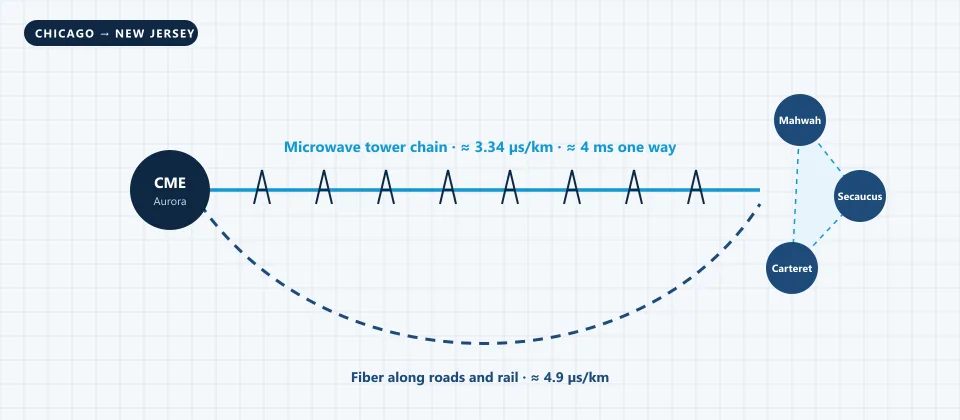
Price information travels between financial centres over radio towers, fiber and, increasingly, exotic media such as hollow-core fiber and shortwave radio. Each medium trades speed against bandwidth, reliability and cost.
This section maps the key routes, from Chicago to New Jersey and New York to London to Tokyo, and explains the physics that sets the theoretical floor for every latency-sensitive strategy.
From the speed of light in glass to microwave towers and hollow-core fiber: how trading networks are designed, measured and paid for — and what cloud-hosted exchanges change.
Research roadmap
Our editorial plan for this section. Published guides are linked; the rest are in research.