
Key takeaways
- Ultra-low latency networks minimise the time market data and orders spend travelling between data centers, venues and trading servers.
- Light travels about a third slower in standard fiber than in air, which is why the fastest long-haul routes use microwave, millimetre wave and, increasingly, hollow-core fiber.
- Every network has a latency budget: transmission, switching, serialisation and processing. Jitter — variability — often matters as much as average latency.
- Private networks deliver the best speed but cost the most; shared networks and managed services give most firms near-competitive latency at a fraction of the cost.
- Exchange cloud migration, led by CME’s move to Google Cloud with Aurora colocation targeted for late 2027, will reshape how latency is engineered and sold.
What is an ultra-low latency network?
An ultra-low latency network moves market data and orders between trading venues and trading systems as fast as physics allows. It combines the shortest possible routes, the fastest transmission media and minimal processing in between, so that a firm sees price changes and reaches matching engines before competitors.
In most industries, a network is judged by bandwidth and uptime. In latency-sensitive trading, the defining metric is time: how long a packet takes from one point to another, and how consistently it does so. A few microseconds can decide whether a firm wins a latency arbitrage race or whether a market maker’s quote is picked off.
Ultra-low latency networking spans three distances:
- Long haul: between financial centres, such as Chicago and New Jersey or London and Frankfurt.
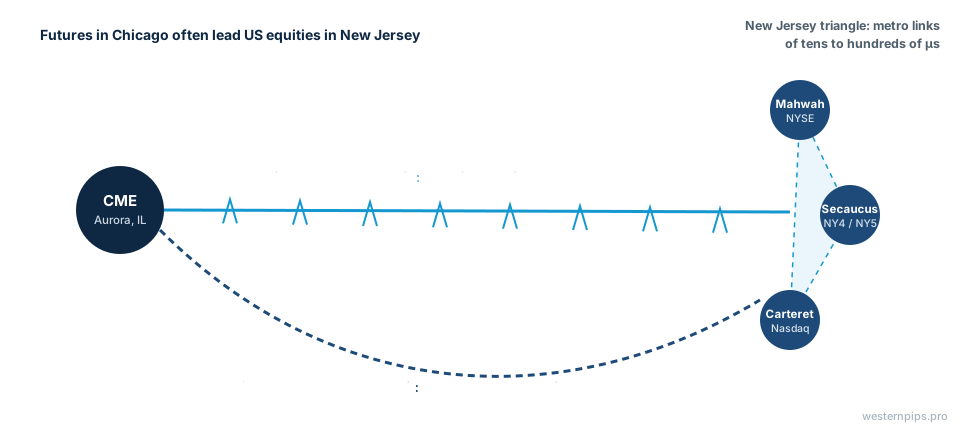
- Metro: between data centers in the same region, such as the New Jersey “triangle” of Mahwah, Carteret and Secaucus.
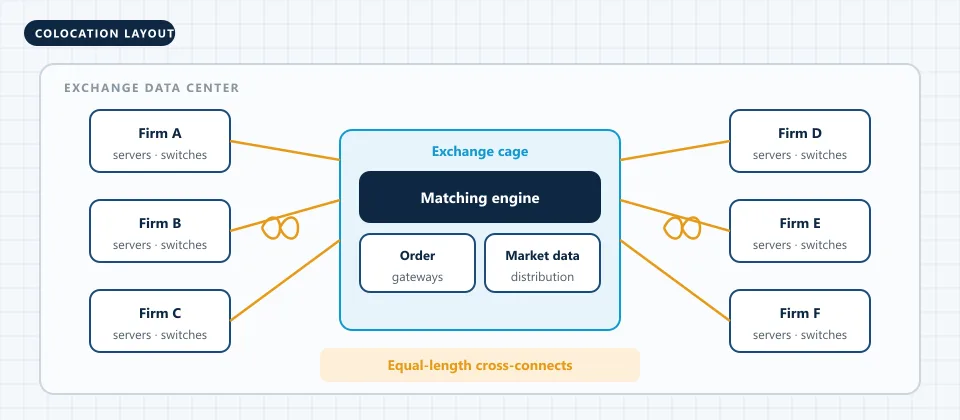
- Inside the data center: from the exchange cross-connect to the trading server’s network card.
The latency budget: where every microsecond goes
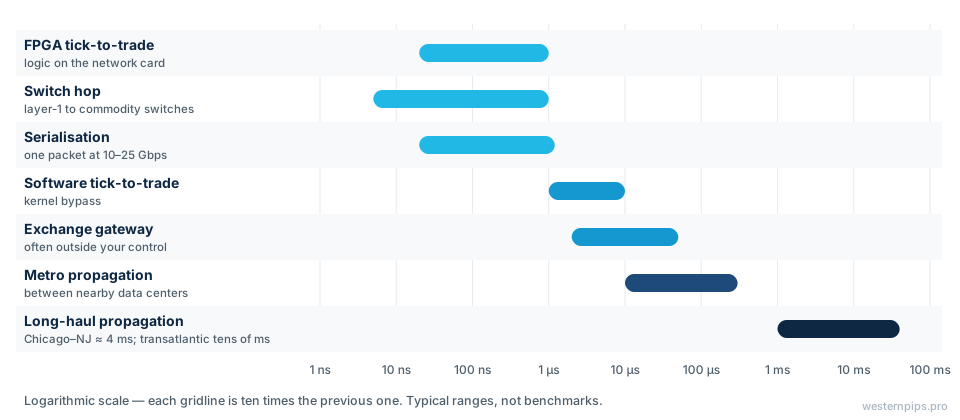
A latency budget breaks end-to-end delay into its parts: propagation through the medium, serialisation onto the wire, switching and routing hops, exchange gateway processing and the trading system’s own tick-to-trade time. Optimising only one component rarely helps; competitive firms measure and attack all of them.
| Component | Typical scale | How firms reduce it |
|---|---|---|
| Propagation (long haul) | Milliseconds | Straighter routes, faster media |
| Propagation (metro) | Tens to hundreds of microseconds | Microwave or hollow-core between sites |
| Serialisation | Nanoseconds per packet at 10–25 Gbps | Higher line rates, smaller packets |
| Switching | Nanoseconds to microseconds per hop | Layer-1 switches, fewer hops |
| Server processing | Microseconds (software), nanoseconds (FPGA) | Kernel bypass, FPGAs |
| Exchange gateway | Microseconds | Venue-specific; often outside your control |
AMD and Exegy reported a STAC-T0 benchmark in 2024 with trade execution times below 20 nanoseconds inside an FPGA — a reminder that, once the network is optimised, the remaining delays are tiny and expensive to remove.
Figure 1: Orders of magnitude in a trading latency budget
Transmission media compared
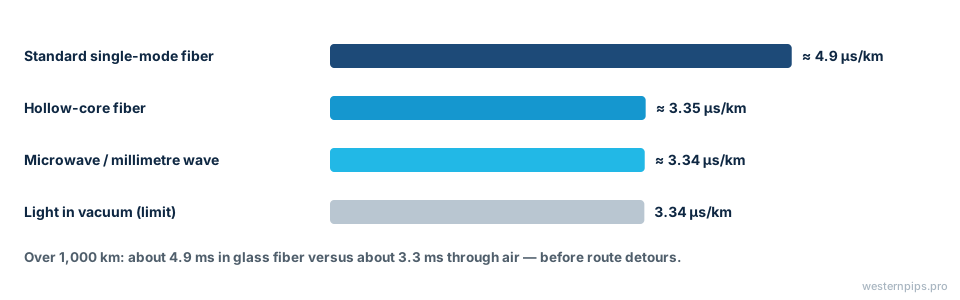
Light in standard single-mode fiber travels about a third slower than in air because glass has a refractive index of roughly 1.47. Microwave and millimetre-wave radio travel at almost the vacuum speed of light over line-of-sight towers. Hollow-core fiber closes most of that gap while keeping fiber’s bandwidth.
Fiber, hollow-core fiber and microwave
- Standard fiber: about 4.9 microseconds per kilometre, huge bandwidth, unaffected by weather, but follows roads and rail lines rather than straight lines.
- Hollow-core fiber: light travels through air inside the fiber, at roughly 3.35 microseconds per kilometre — around 30% faster than glass. Deployment is still limited and expensive.
- Microwave: close to 3.34 microseconds per kilometre plus small detours between towers. Limited bandwidth and vulnerable to rain fade.
Millimetre wave, laser and shortwave
- Millimetre wave: higher frequency than microwave, more bandwidth over short hops, even more weather-sensitive.
- Free-space optics (laser): very high bandwidth and speed over short line-of-sight links, used for metro and last-mile segments.
- Shortwave (HF) radio: bounces off the ionosphere to cross oceans faster than subsea cable, but carries only tiny amounts of data — enough for compact trading signals.
Figure 2: Propagation delay per kilometre
Key routes in global trading
The most contested routes connect futures and equity markets: Chicago to the New Jersey data centers, New York to London, London to Frankfurt and the Asia–Europe links to Tokyo, Hong Kong and Singapore. On Chicago–New Jersey, the fastest microwave networks reach roughly 4 milliseconds one way, close to the physical limit.
| Route | Why it matters | Fastest media in use |
|---|---|---|
| Chicago (CME Aurora) – New Jersey | Futures lead US equities | Microwave, millimetre wave |
| New York/New Jersey – London | Transatlantic FX and equities | Low-latency subsea fiber, shortwave |
| London – Frankfurt | European futures and equities | Microwave |
| Tokyo – London / Hong Kong – Singapore | Asia–Europe arbitrage | Subsea fiber; new Arctic route planned |
The history of the Chicago–New Jersey route illustrates the arms race: a dedicated fiber line cut round-trip latency to about 13 milliseconds in 2010, and microwave networks then reduced it to around 8–9 milliseconds round trip within a few years.
Figure 3: Chicago to New Jersey, the most contested route
Network design: redundancy versus speed
Fast media are fragile: microwave links fade in heavy rain and single towers can fail. Professional networks pair a fast primary path with diverse fiber backups, use automatic failover and route only latency-critical signals over the fastest links while bulk data takes the cheaper path.
Design principles used by most trading networks:
- Tiering: send compact trading signals over microwave or shortwave; send full market data and order traffic over fiber.
- Path diversity: physically separate backup routes, so a single construction accident cannot take down both.
- Deterministic switching: layer-1 switches and cut-through hardware with fixed, predictable delays.
- Weather awareness: monitoring rain cells along microwave routes and failing over before degradation.
Measuring and monitoring latency
Latency must be measured with hardware timestamps synchronised to a common clock, usually via PTP or White Rabbit. Firms capture packets with network taps at each hop and track percentiles — median, 99th and 99.9th — because tail latency and jitter decide unpredictable race losses.
A sound measurement setup includes:
- Precise time: clocks synchronised with PTP (IEEE 1588) to well under a microsecond.
- Passive capture: taps or mirror ports feeding capture appliances, so measurement does not add latency.
- End-to-end views: wire-to-wire latency, tick-to-trade and order round-trip time per venue.
- Jitter tracking: standard deviation and tail percentiles, alerting on microbursts.
Cost structure: shared versus private networks
A private microwave network or new cable is a multi-million-dollar commitment that only the largest firms can justify. Most firms buy capacity on shared low-latency networks or managed services, accepting a small speed disadvantage in exchange for far lower cost and operational burden.
| Option | Speed | Cost | Typical user |
|---|---|---|---|
| Private tower network | Fastest | Very high capex and opex | Largest HFT firms |
| Shared / wholesale microwave | Near-fastest | Monthly fee per route | Mid-size trading firms |
| Managed low-latency service | Competitive | Bundled with hosting | Brokers, smaller firms |
| Standard fiber / internet | Slowest | Low | Non-latency-sensitive trading |
Colocation fees, cross-connects and market data licences sit on top of transport costs and often exceed them.
Cloud exchanges and the future of low-latency networking
Exchanges are moving matching engines into private cloud regions. CME Group plans Google Cloud-managed services and colocation in Aurora in late 2027, with customer testing from mid-2027. Meanwhile hollow-core fiber, millimetre wave and low-earth-orbit satellites push the physical frontier further.
Three trends will define the next phase:
- Cloud-hosted venues: CME’s Globex migration to a dedicated Google Cloud region near Aurora changes who controls the data center — and how latency is priced and equalised. A Dallas disaster-recovery site has been open for testing since June 2026.
- New media: hollow-core fiber on metro routes and millimetre-wave upgrades on long-haul links continue to shave microseconds.
- Satellites: inter-satellite laser links in low-earth orbit could, in theory, beat subsea fiber on very long routes such as London–Tokyo, although ground-segment delays and jitter remain obstacles.
Frequently asked questions
What is an ultra-low latency network in trading?
It is a network engineered to move market data and orders between trading venues and trading systems as fast as physically possible, typically using the shortest routes, the fastest transmission media and specialised switches, with latency measured in microseconds or nanoseconds.
Is microwave faster than fiber for trading?
Yes. Radio waves travel through air at almost the speed of light, while light in standard glass fiber travels roughly 30% slower. Microwave routes can also follow straighter paths. Fiber, however, offers far more bandwidth and better reliability in bad weather.
What is jitter and why does it matter?
Jitter is the variability of latency from one packet to the next. A network with low average latency but high jitter can still lose races unpredictably, so trading firms track latency percentiles and tail behaviour, not just averages.
How much does a low-latency trading network cost?
Costs range widely. Shared microwave or managed low-latency services can cost thousands to tens of thousands of dollars per month per route, while private tower networks and new cable builds require multi-million-dollar investments. Colocation, cross-connects and market data add further recurring costs.
What is hollow-core fiber?
Hollow-core fiber guides light through an air-filled core instead of solid glass. Because light travels close to its vacuum speed in air, it cuts latency by roughly 30% compared with standard single-mode fiber, while keeping fiber’s bandwidth and weather independence.
Sources and further reading
- Ultra-low latency trading: how low can you go? (sponsored, AMD) — Risk.net, 2024
- CME Group announces cloud migration milestones — CME Group, 2026
- Quantifying the High-Frequency Trading Arms Race (OP 50) — Financial Conduct Authority, 2020

Svetlana Berezhnova is a co-founder of Westernpips and has been a trader since 2007. She has been with the company from its very beginning and is an expert in high-frequency trading and latency-sensitive trading software.
This article is for educational purposes and describes market structure; it is not investment, legal or tax advice. Statistics are attributed to their original sources, which should be consulted for methodology and limitations.