
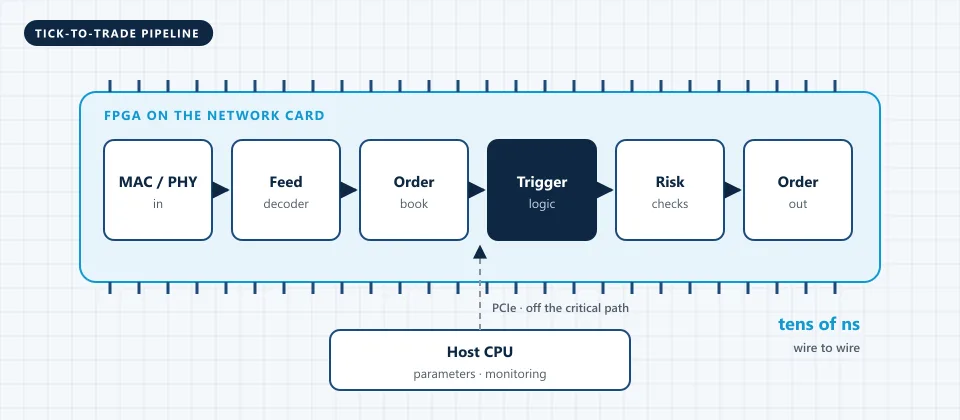
FPGA in High-Frequency Trading: The Complete Guide
Why trading firms moved the critical path from CPUs to FPGAs, what runs in hardware, how teams build it, what it costs — and when software is still good enough.
FPGAs, tick-to-trade latency, kernel bypass networking, smart NICs, layer 1 switches, Linux tuning and low-latency C++.
When the network is as fast as physics allows, the remaining edge lives inside the server. FPGAs, kernel bypass and careful systems engineering shave the final microseconds and nanoseconds.
We explain the hardware and software stack behind competitive tick-to-trade numbers and where each technology is worth its cost.
Why trading firms moved the critical path from CPUs to FPGAs, what runs in hardware, how teams build it, what it costs — and when software is still good enough.
Research roadmap
Our editorial plan for this section. Published guides are linked; the rest are in research.