

Market Microstructure

How electronic markets really work: limit order books, order flow, toxicity, price discovery and the mechanics behind every fill.

Market Microstructure: an overview

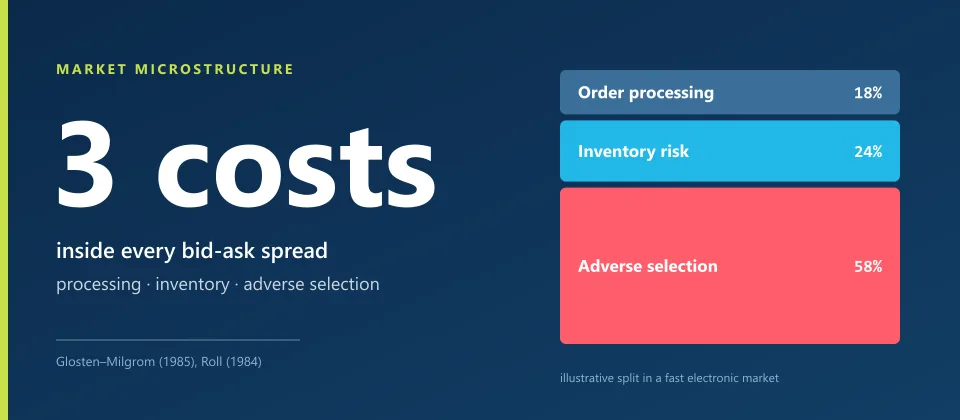
Market microstructure studies how trading rules, order types and participant behaviour turn orders into prices. For an institutional desk it explains why a quote is where it is, why it moves and what each fill really costs.

Our microstructure coverage starts from the limit order book and works outward: order flow and its information content, toxicity metrics such as VPIN, queue dynamics, market impact and the way fragmentation across lit, dark and internalised venues changes execution quality.

Latest Market Microstructure research

Browse all research

Key concepts

Limit order book
The ranked list of resting buy and sell orders at a venue, sorted by price and then by priority rule.
Order flow toxicity
The probability that incoming orders are informed, leaving liquidity providers with adverse selection losses.
Price discovery
The process by which new information is incorporated into traded prices across venues.

Research roadmap

What we cover in Market Microstructure

Our editorial plan for this section. Published guides are linked; the rest are in research.

  • Live Market Microstructure: How Electronic Markets Actually Work
  • Soon What Is Order Flow? An Institutional Perspective
  • Soon Order Flow Toxicity: Measuring Informed Trading With VPIN
  • Soon Order Book Imbalance as a Short-Term Price Predictor
  • Soon How Exchanges Match Orders: Inside the Matching Engine
  • Soon Order Types Used by Professional and HFT Traders
  • Soon Market Impact: How Large Orders Move Prices
  • Soon The Essential Market Microstructure Reading List
  • Soon Speed Bump Exchanges: Do They Stop Latency Arbitrage?
  • Soon The Economics of Queue Position in Limit Order Books