
Key takeaways
- Latency arbitrage is trading against a quote that has become stale because new public information reached one firm before the quote could be updated.
- FCA research found races happen about once a minute per FTSE 100 stock, last 5–10 microseconds in the modal case and cover roughly 20% of trading volume.
- Races account for about a third of the effective spread; eliminating them would cut the cost of liquidity by about 17%, worth roughly $5 billion a year in global equities.
- It is legal in major markets when based on public data, but venues, LPs and brokers can and do restrict it through speed bumps, last look and contract terms.
- In 2026 the edge is concentrated in a handful of firms with private networks and hardware; for most participants the practical question is how to avoid being the stale quote.
What is latency arbitrage?
Latency arbitrage is trading against a price quote that has become stale. When new public information moves the market, the fastest firm trades with resting orders that still show the old price — before the firms that posted them can cancel or update. The profit comes from being microseconds faster, not from predicting the market.
Every electronic market has a delay between an event and the moment each participant can react to it. Market data must travel from a matching engine to traders, through networks, switches and servers, and orders must travel back. Those delays are small, but they are never equal.
Latency arbitrage exists in that gap. If E-mini S&P 500 futures tick up in Chicago, the fair value of the SPY ETF in New Jersey rises at the same instant — but SPY quotes do not. For a few microseconds, a seller’s offer in SPY sits below fair value. The first firm to buy it captures the difference; the market maker who posted it takes a small loss.
The industry and academics use several names for the same mechanism: stale quote arbitrage, sniping, pick-offs or simply latency races. Economists Eric Budish, Peter Cramton and John Shim argued in 2015 that continuous limit order books make such races inevitable, because every public price change creates a moment when “being first” is worth money.
How a latency arbitrage race works, step by step
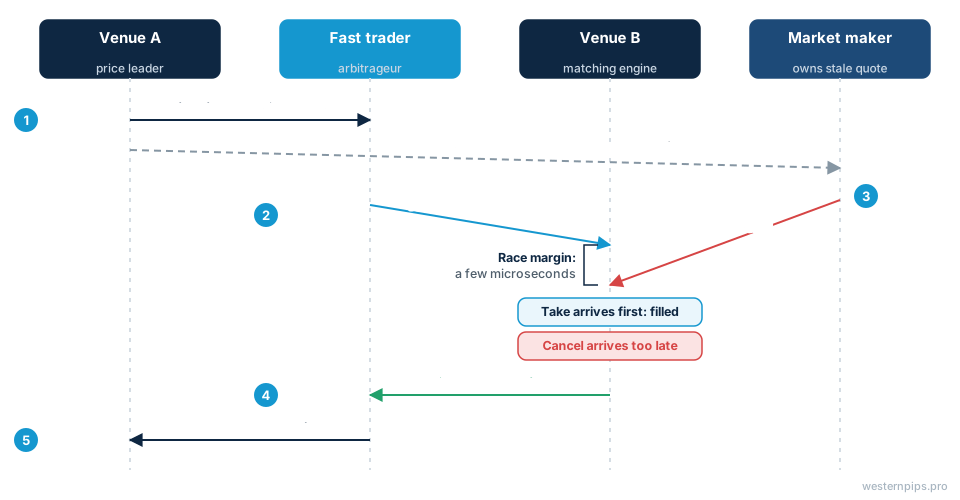
A race begins when a public signal — a trade, a quote change in a related instrument or a price on another venue — makes some resting orders stale. Fast traders send orders to take those quotes, while the quote owner sends a cancel. Whichever message reaches the matching engine first decides who wins.
A typical race in equities or futures follows the same sequence:
- Signal. A price moves on a leading market (often futures, or the venue where a large trade printed).
- Detection. Firms receive the update over their fastest data path — a direct feed delivered over microwave rather than a consolidated feed.
- Decision. Pre-computed logic, often on an FPGA, decides within nanoseconds that a quote on another venue is now mispriced.
- Submission. Several fast firms send “take” orders (often immediate-or-cancel) at the stale price; the liquidity provider sends a cancel or replace.
- Resolution. The matching engine processes messages in arrival order. One taker fills, the others fail, and the provider’s cancel arrives too late.
The FCA’s study captured exactly these patterns in London Stock Exchange message data: clusters of near-simultaneous take attempts and cancels at the same price level, separated by microseconds. Crucially, the study counted the failed messages too, which is how it could see races that left no trace in trade data alone.
Figure 1: Anatomy of a latency arbitrage race
A worked example with numbers
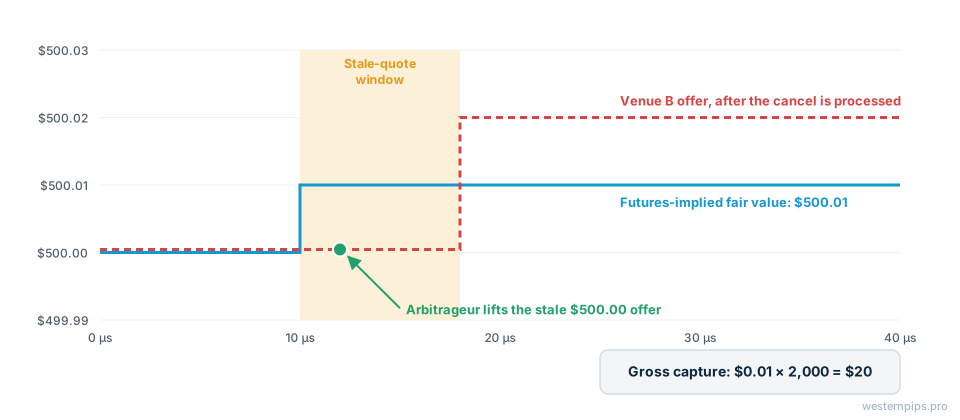
The figures below are illustrative, but the structure is typical of an equity race:
| Step | What happens | Value |
|---|---|---|
| Before the signal | SPY offer on Exchange B | 2,000 shares at $500.00 |
| Signal | E-mini futures tick up; implied SPY fair value | $500.01 |
| Race | Arbitrageur buys the stale offer before it is cancelled | 2,000 × $0.01 = $20 gross |
| Costs | Taker fee at an assumed $0.0030 per share | −$6 |
| Result | Net capture per race, before infrastructure costs | ~$14 |
Fourteen dollars is trivial — unless it happens thousands of times a day across hundreds of symbols. That is exactly the pattern the regulator data show: each race is worth about half a tick, but races are constant.
Figure 2: The stale-quote window in the worked example
Direct feeds vs consolidated feeds
Much of the speed gap starts with data. In US equities, exchanges sell direct feeds that reach subscribers faster than the consolidated SIP feed, which aggregates every venue’s quotes. A firm reading direct feeds over microwave sees a price change before a participant relying on the SIP or on a slower vendor feed. The same gap exists in FX between primary venue data and aggregated broker streams.
Latency arbitrage vs other types of arbitrage
Latency arbitrage is a speed-driven form of cross-venue arbitrage: the price gap exists only because information has not arrived everywhere yet. Triangular and statistical arbitrage exploit relationships between instruments instead. Front-running is different again — it uses knowledge of a client’s pending order and is illegal.
When people ask about the “three types of arbitrage”, they usually mean spatial (cross-venue), triangular and statistical arbitrage. The table puts latency arbitrage in that context.
| Strategy | What creates the opportunity | Holding period | Main risk | Legal status |
|---|---|---|---|---|
| Latency arbitrage | Stale quote after a public price change | Microseconds to milliseconds | Losing the race; adverse fills | Legal on public data |
| Cross-venue (spatial) arbitrage | Same asset priced differently on two venues | Seconds to minutes | Transfer, settlement and counterparty risk | Legal |
| Triangular arbitrage | Cross rate out of line with two base rates | Milliseconds | Partial fills across three legs | Legal |
| Statistical arbitrage | Related assets diverge from historical relationship | Minutes to weeks | Relationship breaks down | Legal |
| Front-running | Knowledge of a client order before it executes | Varies | Regulatory enforcement | Illegal |
The distinction matters because the policy debate is often confused. Latency arbitrage uses information that is public — it is simply faster than everyone else. That makes it legal, but it also explains why its costs fall on liquidity providers and, ultimately, on the investors who pay wider spreads.
How big is latency arbitrage? What the FCA and BIS data show
The best evidence comes from the UK. Using complete London Stock Exchange message data, FCA economists found races about once per minute per FTSE 100 stock, covering about 20% of trading volume and roughly a third of the effective spread. Eliminating them would cut liquidity costs by about 17% — some $5 billion a year in global equities.
The study by Matteo Aquilina (FCA), Eric Budish (University of Chicago) and Peter O’Neill (FCA) was first published as FCA Occasional Paper 50 in January 2020 and later in the Quarterly Journal of Economics (2022, vol. 137). Its main findings:
Figure 1: The footprint of latency arbitrage races in UK equities
Two details are worth noting. First, the average race is worth only about half a tick — tiny per trade, large in aggregate because races are so frequent. Second, the BIS version reports a tax of 0.42 basis points of traded value (about £60 million a year in the UK), while the abstract rounds this to “roughly 0.5 basis points”. Both figures appear in the official publications; the difference is rounding, not a revision.
The $5 billion global figure is an extrapolation from UK data, and HFT industry groups have challenged how well it travels to other markets. Even so, it remains the only estimate built from full message-level data, and no study since has produced a credible alternative.
Where latency arbitrage happens
Latency arbitrage appears wherever the same or related prices are quoted in more than one place: between exchanges, between futures and cash markets, inside dark pools that reference lit prices, across FX liquidity providers and across crypto venues, including on-chain.
Exchange order books
Fragmented equity markets are the classic setting. In the US, an instrument trades on more than a dozen exchanges plus dark pools and wholesalers, all reacting to the same futures and index signals. Futures-to-cash races between CME’s Aurora data center and the New Jersey equity exchanges are the benchmark example.
Dark pools
Dark pools usually execute at the midpoint of the lit market’s best bid and offer. If that reference price moves and the pool has not updated yet, a fast trader can trade at the old midpoint. A 2023 BIS study of UK dark pools (“Sharks in the dark”) found at least 4% of dark trading executes at stale reference prices, that HFTs drive 83% of these cases, and that they land on the profitable side 96–99% of the time. Randomising dark execution times proved an effective countermeasure.
FX
Spot FX has no single exchange: prices are streamed by banks and non-bank liquidity providers and redistributed by venues, aggregators and brokers. Any participant quoting from a slower source is exposed. This is why most FX liquidity providers use last look — a short window to reject trades whose price has moved — and why the FX Global Code’s Principle 17 restricts how that window may be used.
Crypto: centralised venues and on-chain time auctions
Crypto exchanges are often hosted in public cloud regions, so latency races play out between cloud availability zones rather than private colocation halls. On-chain, the same economics appear as transaction-ordering competition (MEV). Some networks now auction speed openly: Arbitrum’s Timeboost, launched in April 2025, sells an “express lane” while delaying other transactions by a default 200 milliseconds. A 2025 study of its first months found two entities winning more than 90% of auction rounds — the same concentration seen in traditional races.
A short history of the latency arms race
The modern arms race began when markets fragmented and became fully electronic in the 2000s. In 2010 a dedicated fiber line cut Chicago–New York round-trip latency to about 13 milliseconds; within a few years microwave networks undercut it, and the fight moved to microseconds, hardware and new transmission media.
- 2005–2007: Regulation NMS in the US and MiFID I in Europe encourage competition between venues, so the same stocks trade in many places at once.
- 2010: Spread Networks opens a near-straight fiber route between Chicago and New Jersey, cutting round-trip latency to roughly 13 milliseconds.
- 2011–2014: Microwave tower networks reduce the same route to around 8–9 milliseconds round trip. Michael Lewis’s Flash Boys (2014) brings latency races to a mainstream audience.
- 2015: Budish, Cramton and Shim publish their case for frequent batch auctions as a market-design fix.
- 2016: The SEC approves IEX, with its 350-microsecond speed bump, as a national exchange.
- 2020–2023: The FCA and BIS publish the first full measurements of races on lit exchanges and in dark pools.
- 2025–2026: Speed is auctioned openly on some blockchains, asymmetric speed bumps reach the options market debate, and exchanges move matching engines into dedicated cloud regions.
The infrastructure behind the race
Winning races requires the shortest possible path from signal to matching engine: colocated servers, private microwave or millimetre-wave links between data centers, kernel-bypass or FPGA-based processing and precise time synchronisation to measure it all. Each layer removes microseconds; together they decide who arrives first.
Physics sets the floor
Light in standard optical fiber travels about a third slower than in air, because glass has a refractive index of roughly 1.47. That is why latency-sensitive firms moved from fiber to microwave towers on routes such as Chicago–New Jersey, and why new media are being tested.
| Medium | One-way delay per 1,000 km (approx.) | Trade-off |
|---|---|---|
| Vacuum (theoretical limit) | 3.34 ms | — |
| Microwave / millimetre wave (air) | ~3.34 ms plus route detours | Low bandwidth, weather fade |
| Hollow-core fiber | ~3.35 ms | Limited deployment, cost |
| Standard single-mode fiber | ~4.9 ms | High bandwidth, longer routes |
| Shortwave radio (ionospheric) | Close to air speed over oceans | Very low bandwidth, variable |
On the Chicago–New Jersey corridor, the fastest microwave networks deliver one-way latency of roughly 4 milliseconds, close to the speed-of-light limit for the distance. Across the Atlantic, the fastest subsea fiber needs just under 30 milliseconds one way, against a theoretical vacuum minimum of about 18.6 milliseconds — the gap that shortwave radio is used to narrow for small trading signals.
Inside the data center
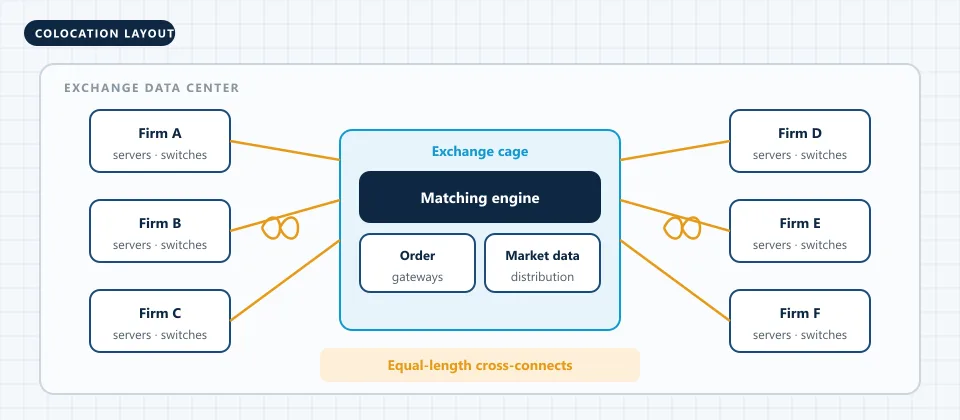
Colocation places servers in the exchange’s own facility, with equal-length cross-connects so no client gains a physical advantage inside the building. From there, the race is decided by tick-to-trade latency: the time from a market data packet arriving to an order leaving. Competitive software stacks with kernel bypass operate in low single-digit microseconds; FPGA-based systems reach the hundreds-of-nanoseconds range and below. Our guide to ultra-low latency networks covers the transport layer in depth.
Time synchronisation with PTP (IEEE 1588) or White Rabbit is what makes any of this measurable. Without hardware timestamps accurate to well under a microsecond, a firm cannot tell whether it lost a race by 2 microseconds or 20.
Who pays and who wins
Liquidity providers pay directly, because their stale quotes are the ones picked off. They pass the cost on through wider spreads and smaller displayed size, so investors and institutions pay indirectly. The winners are a small group of firms with the fastest infrastructure — the FCA data show the top six account for over 80% of race wins and losses.
The economics resemble an insurance premium. A market maker knows that some fraction of its fills will be stale pick-offs, so it widens its quotes to cover the expected loss. The FCA estimates imply that, without races, spreads and price impact in UK equities would be materially lower.
Concentration is the other striking result. The same handful of firms appear on both sides: they win many races as takers and lose many as liquidity providers. For institutional investors, the practical impact shows up in transaction cost analysis as adverse selection — fills that look good at the moment of execution and poor a few milliseconds later.
Is latency arbitrage legal?
Yes, in the US, UK and EU latency arbitrage is legal when it is based on public market data and does not involve manipulation. It crosses the line when it uses non-public information, such as a client’s pending order, or when it is combined with spoofing or layering. Venues and counterparties may still restrict it contractually.
Three boundaries matter in practice:
- Front-running is not latency arbitrage. Trading ahead of a known client order breaches conduct rules in every major jurisdiction. Latency arbitrage reacts to information everyone receives, just later.
- Manipulation rules apply regardless of speed. Placing orders intended to be cancelled to move prices (spoofing, layering, quote stuffing) is prohibited under the US Commodity Exchange Act and Securities Exchange Act and under the EU Market Abuse Regulation.
- Contracts can prohibit it. Many retail FX and CFD brokers, and most proprietary trading “evaluation” firms, forbid strategies that exploit delayed prices in their terms. Breaking those terms is not a crime, but it can lead to cancelled trades and closed accounts.
How markets are fighting back
Exchanges and regulators use four main tools: symmetric speed bumps that delay all orders, asymmetric bumps that protect liquidity providers, frequent batch auctions that make tiny speed differences worthless, and randomised execution times. In FX, last look plays the same role; in crypto, some networks auction priority openly.
- Symmetric speed bumps. IEX delays every incoming order and outgoing message by 350 microseconds and uses a signal to reprice pegged orders before fast traders can act on stale prices. The SEC approved IEX as an exchange in 2016. A 2026 study of NYSE American’s speed bump also found reduced latency arbitrage and more participation by slower traders.
- Asymmetric speed bumps. These delay only liquidity-taking orders, giving providers time to update. They are more controversial: in 2025, IEX’s proposal to launch an options exchange with an asymmetric design (filing SR-IEX-2025-02) drew comment letters arguing it would advantage market makers and create “illusory” liquidity.
- Frequent batch auctions. Proposed by Budish, Cramton and Shim, batch auctions collect orders over short intervals (for example 100 milliseconds) and execute them together at one price, so being a microsecond faster stops mattering. The same idea has been adapted for crypto as “dual flow batch auctions”.
- Randomisation. Random execution delays in dark pools neutralised stale-price trading in the BIS study.
US market structure reforms also matter. The SEC’s 2024 amendments to Regulation NMS introduce a half-penny tick size for tightly spread stocks and lower access fee caps. Because the average race is worth about half a tick, smaller ticks change the size of the prize. Compliance, originally due in November 2025, was pushed to November 2026 by SEC exemptive relief.
Is latency arbitrage still profitable in 2026?
For a few firms with private networks, colocation and hardware acceleration, latency arbitrage remains a meaningful business, because races are still frequent. For everyone else it is not: infrastructure costs are high, the winners are concentrated, and venues increasingly design markets to protect stale quotes.
The arms race has become an exercise in diminishing returns. Moving from fiber to microwave saved milliseconds; moving from microwave to millimetre wave or hollow-core fiber saves microseconds; FPGA optimisation saves nanoseconds. Each step costs more and protects a smaller edge.
Discussions among practitioners on trading forums reach a consistent conclusion: retail traders cannot win speed races against colocated firms, and strategies built on slow broker feeds tend to stop working once brokers detect them. Claims of high monthly returns from “latency arbitrage software” usually come from vendors and should be treated as marketing.
The more durable opportunity has shifted to measurement and protection: knowing when your own quotes are stale, choosing venues and liquidity providers with fair designs, and pricing flow according to its toxicity.
What latency arbitrage means for your desk
Whether you run a market-making book, a broker or an execution desk, the useful question is not how to win races but how much they cost you. Measure markouts, know your latency to every venue, audit price sources for staleness and choose venues and counterparties whose design matches your flow.
A practical checklist:
- Market makers and LPs: measure short-horizon markouts (for example 1 ms, 10 ms, 100 ms) by counterparty and venue; monitor quote-update latency end to end; review whether last look or speed-bump venues reduce adverse selection without hurting fill quality.
- Brokers: benchmark the latency of every price source against the primary market; flag accounts whose profits come only from trades placed while your feed lagged; disclose execution practices clearly.
- Buy-side execution desks: use TCA to separate spread and impact from adverse selection; prefer venues with protections against stale-price trading for passive orders; be cautious with midpoint orders on pools that update slowly.
- Technology teams: timestamp everything with hardware clocks traceable to UTC; measure, do not assume, your tick-to-trade and quote-update times.
How brokers and liquidity providers detect latency arbitrage
Detection relies on the same signature every time: profits concentrated in trades placed while the receiving side’s price was behind the market. The common methods are:
- Markout analysis: comparing each fill with the market price a few milliseconds to seconds later. Stale-quote trades show consistently positive markouts for the counterparty.
- Feed-lag correlation: matching trade timestamps against moments when the internal price lagged a reference feed.
- Holding-time and win-rate patterns: very short holding periods with unusually high win rates, clustered around fast market moves.
- Account clustering: identifying groups of accounts that trade the same instruments at the same moments.
How to measure your own exposure
- Record hardware timestamps for every quote update you send and every fill you receive.
- For each fill, find the last reference-market price change before it and compute how long your quote had been stale.
- Compute markouts at several horizons and segment them by venue, counterparty and time since the last reference move.
- Fills that cluster within microseconds of reference moves and show negative markouts for you are the cost of latency arbitrage on your book.
Frequently asked questions
What is latency arbitrage trading?
Latency arbitrage trading is a strategy that profits from being first to react to public information. When a price moves on one venue, the fastest firm trades against quotes elsewhere that have not yet updated — the stale quotes — before their owners can cancel or reprice them.
Is latency arbitrage illegal?
No. In the US, UK and EU, trading quickly on public market data is legal. It becomes illegal if it relies on non-public information (front-running a client order) or on manipulation such as spoofing. Venues, liquidity providers and retail brokers may still prohibit or limit it in their rules and contracts.
What are the three types of arbitrage?
Traders usually mean spatial or cross-venue arbitrage (the same asset on two venues), triangular arbitrage (three related currency or crypto pairs) and statistical arbitrage (related assets that tend to move together). Latency arbitrage is a speed-driven form of cross-venue arbitrage.
Is latency arbitrage still profitable in 2026?
For a small number of firms with private networks, colocation and hardware acceleration, yes — races remain frequent. Profits are concentrated: FCA data show the top six firms account for over 80% of race wins and losses. For firms without that infrastructure, and for retail traders, it is generally not profitable after costs.
How long does a latency arbitrage race last?
Very briefly. In the FCA's study of London Stock Exchange data, the modal race lasted 5–10 millionths of a second (5–10 microseconds). Winning margins are often a few microseconds.
How do exchanges stop latency arbitrage?
The main tools are speed bumps (such as IEX's 350-microsecond delay), asymmetric delays that let liquidity providers update quotes first, frequent batch auctions that remove the value of tiny speed differences, and randomised execution times. In FX, liquidity providers use last look.
Sources and further reading
- Quantifying the High-Frequency Trading “Arms Race” (Occasional Paper 50) — Financial Conduct Authority — Aquilina, Budish and O'Neill, 2020
- Quantifying the high-frequency trading “arms race” (Working Paper 955) — Bank for International Settlements, 2021
- Quantifying the High-Frequency Trading Arms Race (NBER w29011; Quarterly Journal of Economics 137(1)) — NBER / QJE, 2021
- Sharks in the dark: quantifying HFT dark pool latency arbitrage (Working Paper 1115) — Bank for International Settlements — Aquilina, Foley, O'Neill and Ruf, 2023
- SEC adopts amendments to Regulation NMS on tick sizes, access fees and market data (press release 2024-137) — U.S. Securities and Exchange Commission, 2024
- Comment letter on SR-IEX-2025-02 (proposed IEX options exchange with speed bump) — U.S. Securities and Exchange Commission, 2025
- Timeboost for Arbitrum chains — Arbitrum documentation, 2025
- Express lane auction study (arXiv 2509.22143) — arXiv, 2025

Svetlana Berezhnova is a co-founder of Westernpips and has been a trader since 2007. She has been with the company from its very beginning and is an expert in high-frequency trading and latency-sensitive trading software.
This article is for educational purposes and describes market structure; it is not investment, legal or tax advice. Statistics are attributed to their original sources, which should be consulted for methodology and limitations.