
Key takeaways
- A forex liquidity provider streams executable buy and sell prices to clients or venues and takes the other side of their trades.
- Global FX turnover reached $9.6 trillion a day in April 2025 according to the BIS, with spot at about $3 trillion — 31% of the total.
- Liquidity comes from tier-1 banks and non-bank electronic market makers; smaller firms reach it through prime brokers, prime-of-prime providers and ECNs.
- LPs protect themselves from toxic flow with spread tiering, flow segmentation and last look, which the FX Global Code’s Principle 17 regulates.
- Evaluate LPs on fill and reject rates, hold times, markouts, spread consistency and credit terms — not headline spreads alone.
What is a forex liquidity provider?
A forex liquidity provider (LP) is a bank or non-bank firm that continuously streams executable buy and sell prices in currency pairs and takes the other side of client trades. LPs are the source of the prices that brokers, funds, corporates and venues show to the market; without them, spot FX would have no continuous two-way market.
FX is an over-the-counter market. There is no central exchange: liquidity is created by firms willing to quote, and it reaches end users through a chain of intermediaries. Understanding that chain — who quotes, who extends credit and who aggregates — is essential for any broker or fund choosing counterparties.
How big is the FX market?
The BIS Triennial Survey put global FX turnover at $9.6 trillion per day in April 2025, up 28% from 2022. Spot transactions accounted for about $3 trillion a day, or 31% of the total. The rest is FX swaps, forwards, options and currency swaps.
The survey also showed trading with institutional investors rising to 13% of turnover and Singapore increasing its share of global trading to 11.8%, reinforcing Asia’s role in round-the-clock liquidity.
The FX liquidity hierarchy
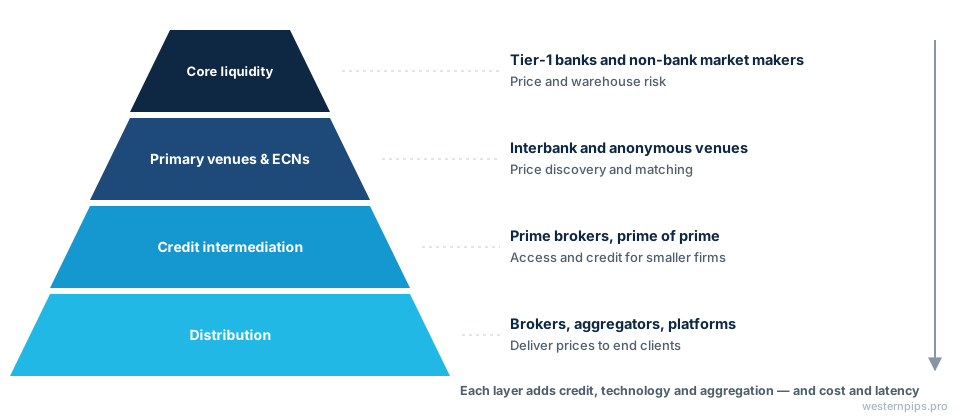
FX liquidity flows through layers: tier-1 banks and large non-bank market makers at the core; primary interbank venues and ECNs where they meet; prime brokers and prime-of-prime firms that extend credit; and brokers, aggregators and trading platforms that deliver prices to end clients.
| Layer | Who | Role |
|---|---|---|
| Core liquidity | Tier-1 banks, non-bank market makers | Price and warehouse risk |
| Primary venues and ECNs | Interbank and anonymous venues | Price discovery, matching |
| Credit intermediation | Prime brokers, prime of prime | Give smaller firms access and credit |
| Distribution | Brokers, aggregators, platforms | Deliver prices to end clients |
Each layer adds value — credit, technology, aggregation — and each adds cost and latency.
Figure 1: The FX liquidity hierarchy
Bank versus non-bank liquidity providers
Tier-1 banks bring balance sheets, broad client franchises and prime brokerage. Non-bank liquidity providers are electronic market-making firms that compete on pricing technology and speed; over the last decade they have become a major source of spot FX liquidity, often reaching clients through banks’ prime brokerage and ECNs.
- Bank LPs internalise large client flows, offer credit and provide a full product range including forwards and swaps.
- Non-bank LPs specialise in algorithmic pricing of spot and short-dated products, often with tighter streaming spreads for well-behaved flow.
Most professional setups use both: banks for credit, breadth and stress resilience; non-banks for competitive streaming prices.
Streaming prices, RFQ and firm liquidity
LPs deliver liquidity in three main ways: streaming executable prices that update continuously, request-for-quote for larger or less liquid trades, and firm order books on venues. Streams may be “last look” — subject to acceptance — or “firm”, meaning they are executable without a rejection window.
- Streaming (ESP): continuous prices, typically tiered by size.
- RFQ: the client asks several LPs for a price on a specific size; common for blocks and forwards.
- Firm liquidity: no last look; fewer rejects but usually wider spreads.
How LPs price and manage risk
LPs price each client according to the expected cost of trading with them. Flow that tends to precede price moves — fast or informed flow — is toxic and gets wider spreads or rejections. Benign flow gets tighter prices. LPs hedge residual risk in the market and internalise offsetting flows wherever possible.
The main tools:
- Tiered pricing by client and flow quality.
- Internalisation — matching opposite client trades on their own books before hedging.
- Skewing quotes to reduce unwanted inventory.
- Last look to reject trades at stale prices.
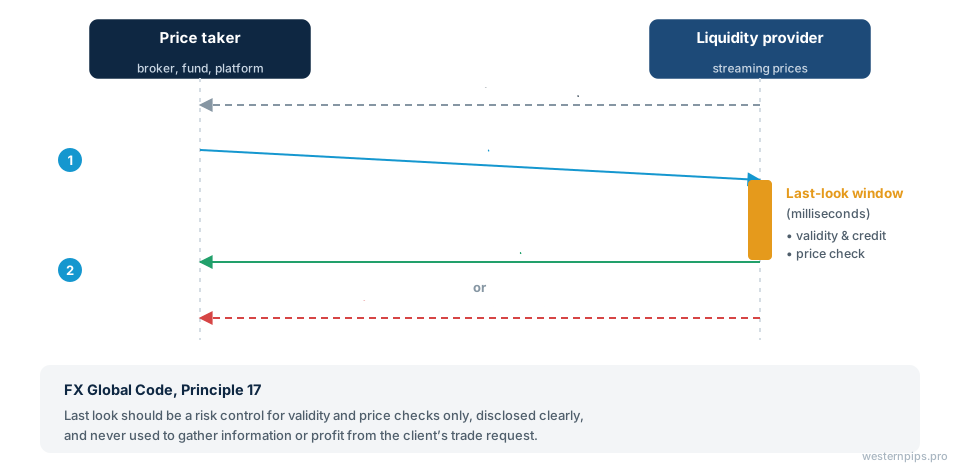
Last look is the most debated. The FX Global Code’s Principle 17 says last look should be used only as a risk control for validity and price checks, should be disclosed clearly and should not be used to gather information or profit from the client’s trade request. Latency-sensitive strategies that target slow prices, discussed in our latency arbitrage guide, are the main reason LPs keep it.
Figure 2: How last look works
Accessing liquidity: prime brokerage, prime of prime and ECNs
Large institutions trade with LPs directly or through a tier-1 prime broker that centralises credit. Smaller brokers and funds that do not meet prime brokers’ requirements use prime-of-prime providers, which extend access to tier-1 credit and liquidity. ECNs and aggregators connect many LPs through one interface.
| Access route | Who uses it | Trade-offs |
|---|---|---|
| Direct bilateral credit | Large banks, big funds | Best pricing, needs strong credit |
| Tier-1 prime brokerage | Funds, large brokers | Centralised credit, high minimums |
| Prime of prime | Smaller brokers and funds | Access to tier-1 liquidity, extra layer of cost |
| ECN / aggregator | Most brokers | Multi-LP access, routing complexity |
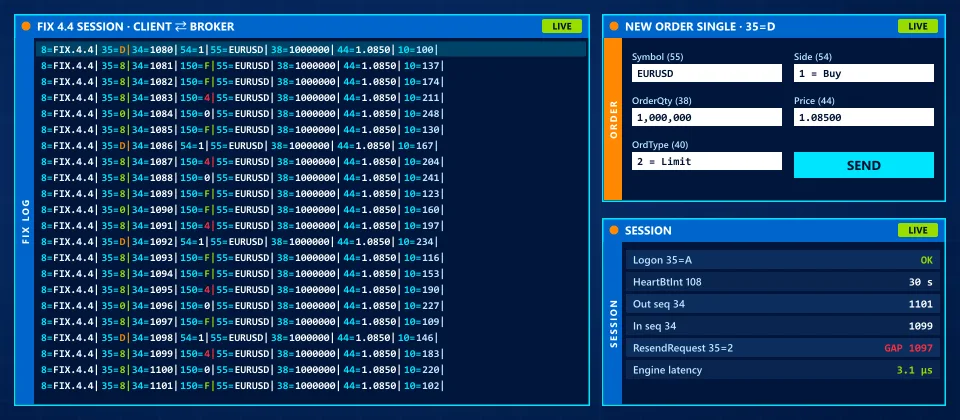
Technology ties it together: FIX API connections to each LP, bridges to retail platforms and aggregation engines that build a consolidated book. Our FIX protocol guide explains the connectivity layer.
Evaluating a liquidity provider
Do not judge LPs by headline spreads. Measure the full cost: fill and reject rates, hold times, slippage, markouts after each fill, spread consistency in volatile markets and credit terms. A slightly wider but firm price often beats a tight stream with frequent rejections.
Metrics to track for every LP:
- Fill ratio and reject rate, broken down by market conditions.
- Hold time — how long last-look decisions take.
- Effective spread — what you actually paid, including rejections and re-quotes.
- Markouts — price moves after your fills, at several horizons.
- Behaviour in stress — whether the LP keeps quoting during news and volatility spikes.
- Credit and settlement — limits, margin terms and counterparty risk.
A-book, B-book and what LPs see from brokers
Brokers either pass client orders through to LPs (A-book), take the other side themselves (B-book) or mix both. LPs observe the flow brokers send and price it accordingly, so brokers that pass toxic flow to LPs see wider spreads or are cut off, while brokers with benign flow receive better pricing.
This feedback loop explains much of the retail FX industry’s structure: brokers profile their clients, route each segment differently and negotiate LP pricing based on the quality of flow they deliver. Transparency about these practices is increasingly expected by regulators and by the FX Global Code.
Frequently asked questions
What is a forex liquidity provider?
A forex liquidity provider is a bank or non-bank firm that continuously quotes executable buy and sell prices in currency pairs and stands ready to trade at them. Brokers, funds and corporates trade against these prices directly or through venues and aggregators.
How do FX liquidity providers make money?
Mainly from the bid-ask spread and from internalising offsetting client flows, which lets them capture spread without hedging in the market. They lose money when they trade against better-informed or faster flow, so they price clients according to the toxicity of their flow.
What is the difference between a tier-1 and a non-bank liquidity provider?
Tier-1 LPs are large global banks with balance sheets, credit relationships and prime brokerage. Non-bank LPs are electronic market-making firms that specialise in pricing technology; they now provide a large share of spot FX liquidity, often through prime brokers and ECNs.
What is prime of prime in FX?
A prime-of-prime provider holds a prime brokerage relationship with a tier-1 bank and extends access to that credit and liquidity to smaller brokers and funds that do not meet the bank’s requirements directly.
What is last look?
Last look is a short window in which a liquidity provider can accept or reject a trade request at its quoted price. It protects LPs from stale-price trading but creates rejection risk for clients; the FX Global Code says it should be used only for validity and price checks, not to profit from the information.
Sources and further reading
- Global FX trading hits $9.6 trillion per day in April 2025 (Triennial Survey) — Bank for International Settlements, 2025
- FX Global Code — Global Foreign Exchange Committee
- Best 25 Liquidity Providers (directory) — LiquidityFinder, 2026

Svetlana Berezhnova is a co-founder of Westernpips and has been a trader since 2007. She has been with the company from its very beginning and is an expert in high-frequency trading and latency-sensitive trading software.
This article is for educational purposes and describes market structure; it is not investment, legal or tax advice. Statistics are attributed to their original sources, which should be consulted for methodology and limitations.