
Key takeaways
- A market data feed is a real-time stream of quotes, trades and order book events from a venue or an aggregator.
- Level 1 shows top of book, Level 2 shows depth by price, and Level 3 (market by order) shows every individual order.
- In US equities, direct exchange feeds arrive faster and carry more detail than the consolidated SIP feed, which is why latency-sensitive firms use them.
- Normalized vendor feeds trade a little latency for convenience: one format across hundreds of venues.
- Licensing — display, non-display and derived-data fees — is often a bigger cost than connectivity; the EU consolidated tape, live since September 2026, adds a new reference feed for Europe.
What is a market data feed?
A market data feed is a real-time stream of quotes, trades and order book events published by a trading venue or an aggregator. Trading systems use it to see prices, run algorithms, manage risk and record history. Which feed you use determines how fast you see the market and how much of it you see.
Every trading decision starts with data. A market maker needs to know the instant the best bid moves; an execution algorithm needs depth to size its child orders; a researcher needs years of clean history. Those needs map to different products — and different costs.
Types of market data: Level 1, Level 2 and Level 3
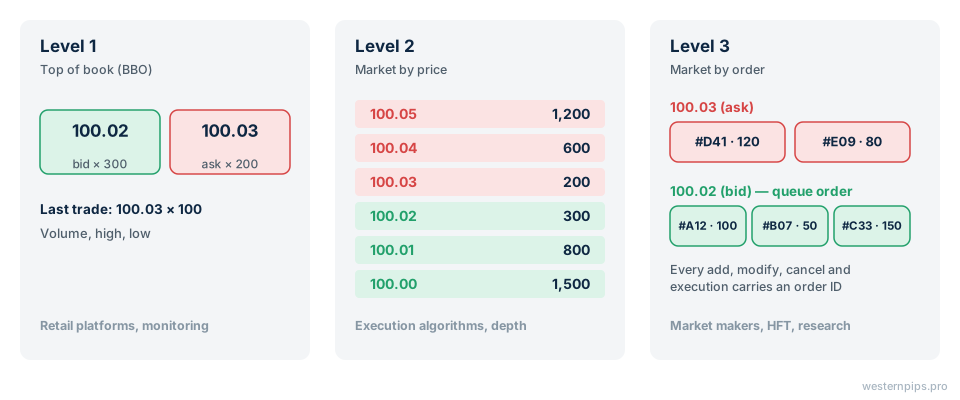
Level 1 shows the best bid, best offer and last trade. Level 2 aggregates the total size at each of several price levels. Level 3 — market by order — shows every individual order with its own ID, letting a trader follow queue position and order lifecycles.
| Level | Also called | Content | Typical user |
|---|---|---|---|
| Level 1 | Top of book, BBO | Best bid/offer, last trade, volume | Retail platforms, monitoring |
| Level 2 | Market by price, depth | Aggregated size at multiple prices | Execution algorithms, discretionary traders |
| Level 3 | Market by order, full depth | Every add, modify, cancel and execution | Market makers, HFT, microstructure research |
Level 3 data — such as Nasdaq TotalView-ITCH or the NYSE Integrated Feed — is what makes queue position modelling and order book reconstruction possible.
Figure 1: What each level of market data shows
Direct feeds versus the SIP
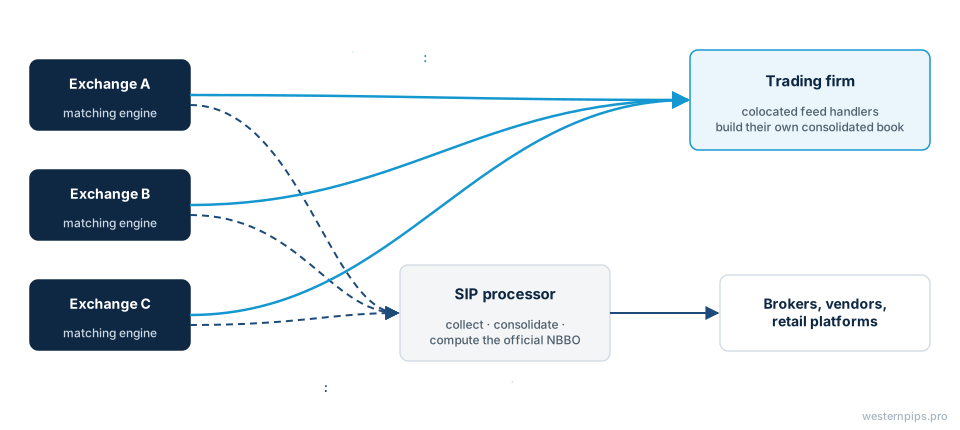
In US equities, each exchange sells its own direct feed, while the Securities Information Processor (SIP) consolidates every exchange’s best quotes and trades into one feed. Direct feeds arrive faster and carry full depth; the SIP is slower because it must collect, combine and redistribute data. Latency-sensitive firms build their own consolidated view from direct feeds.
The US has two equity SIPs — CTA for NYSE- and regionally-listed stocks (Tapes A and B) and UTP for Nasdaq-listed stocks (Tape C) — plus OPRA for options. The SIP defines the official NBBO used for regulatory purposes, but a firm reading direct feeds can see price changes before the SIP publishes them.
That gap is one of the structural sources of latency arbitrage. The SEC’s 2020 Market Data Infrastructure rule aimed to replace the exclusive SIPs with competing consolidators and expand SIP content; its 2024 Reg NMS amendments also redefine round lots and add odd-lot information to consolidated data. Implementation of competing consolidators has been slow.
Figure 2: Direct feeds versus the SIP
Normalized feeds and vendors
Every exchange uses its own protocol and symbology. Normalized feeds from data vendors translate hundreds of venues into one format and API, which saves enormous engineering effort. The trade-off is a few microseconds to milliseconds of added latency and less control over raw data.
| Option | Latency | Engineering effort | Best for |
|---|---|---|---|
| Raw direct feeds + in-house feed handlers | Lowest | Very high | HFT, market makers |
| Managed ticker plant | Low | Medium | Brokers, multi-strategy firms |
| Normalized vendor feed | Moderate | Low | Execution desks, analytics |
| Consolidated/terminal data | Higher | Very low | Discretionary trading, research |
A feed handler is the software or FPGA logic that decodes a raw exchange protocol, maintains the order book and publishes normalized events internally. Building and maintaining feed handlers for every venue is one of the largest hidden costs of in-house market data.
How market data is delivered
Exchanges distribute real-time data mainly by UDP multicast inside colocation facilities, with redundant A and B feeds and recovery services for lost packets. Vendors redistribute over private networks, cross-connects, internet APIs and, increasingly, cloud platforms.
- Multicast (UDP): one stream replicated by the network to every subscriber; fast and fair, but lossy.
- A/B feed arbitration: two identical feeds over separate paths; the handler takes whichever packet arrives first.
- Gap recovery: retransmission requests or snapshot channels refill missed data.
- TCP and WebSocket APIs: common for vendor, crypto and retail feeds.
- Cloud distribution: exchanges and vendors now deliver real-time data inside public cloud regions, lowering the barrier for smaller firms.
Market data licensing and fees
For many firms, licence fees cost more than connectivity. Exchanges charge separately for display use (people looking at screens), non-display use (algorithms consuming data) and derived data, plus port and connectivity fees. Fee schedules are complex and audited, so tracking usage is a compliance task in itself.
Common fee categories:
- Access or distributor fees for receiving the feed.
- Display fees per user or device.
- Non-display fees for automated trading and other machine use, often tiered by use case.
- Derived data fees for indices or analytics built from exchange data.
- Connectivity — ports, cross-connects and network circuits.
Regulators in the US and EU have pressed exchanges to justify data pricing, and MiFID II requires data to be offered on a reasonable commercial basis.
Europe’s consolidated tape goes live
The EU’s first consolidated tape for shares and ETFs began distribution in September 2026. ESMA authorised EuroCTP as the tape provider in July 2026; the tape aggregates data from more than 130 sources and includes a European best bid and offer. A separate consolidated tape for bonds is being implemented.
For European trading firms, the tape creates a common reference for best-execution analysis and transaction cost measurement. It will not replace direct feeds for latency-sensitive trading — consolidated data is inherently slower — but it reduces the cost of a complete view of European equity markets.
Market data in FX and crypto
Spot FX has no consolidated tape: prices come from primary interbank venues, ECNs and liquidity providers’ streams, each showing only part of the market. Crypto exchanges publish order books through WebSocket APIs, usually free, but data quality, timestamps and outages vary widely between venues.
In FX, firms combine streams from multiple liquidity providers through aggregators and must distinguish executable from indicative prices. In crypto, the challenge is consistency: sequence gaps, clock differences and snapshot-plus-diff protocols make building a reliable consolidated book harder than the free price tag suggests.
Choosing market data by strategy
Match the feed to the decision horizon. Microsecond strategies need direct Level 3 feeds in colocation; execution algorithms need fast depth and a reliable consolidated view; risk and analytics can use normalized or consolidated data; research needs clean, well-timestamped history.
- Market making and arbitrage: raw direct feeds, FPGA or kernel-bypass handlers, precise PTP timestamps.
- Agency execution: direct depth plus a robust consolidated view, venue-level fill analytics.
- Risk and surveillance: normalized real-time data with full audit trails.
- Quant research: historical order-by-order data with exchange timestamps and documented gaps.
Frequently asked questions
What is a market data feed?
A market data feed is a continuous stream of price information — quotes, trades and order book changes — published by an exchange or aggregated by a vendor. Trading systems consume it to display prices, run algorithms and record history.
What is the difference between Level 1, Level 2 and Level 3 data?
Level 1 shows the best bid and offer and last trade. Level 2 shows aggregated size at multiple price levels. Level 3, or market-by-order data, shows every individual order with its own ID, which lets you track queue position and order lifecycles.
What is the difference between a direct feed and the SIP?
A direct feed comes straight from one exchange and typically includes full depth. The SIP consolidates top-of-book quotes and trades from all US exchanges into one feed. Because the SIP must collect and combine data, it is slower, so latency-sensitive firms build their own consolidated view from direct feeds.
Why do exchanges use UDP multicast for market data?
Multicast lets an exchange send one stream that the network replicates to every subscriber simultaneously, which is fast and fair. Because UDP does not guarantee delivery, exchanges publish redundant A/B feeds and offer recovery services for missed packets.
Is real-time market data free?
Usually not for professionals. Exchanges charge licence fees for display use, non-display (algorithmic) use and derived data, plus connectivity fees. Delayed data, typically 15 minutes old, is often free or cheap.
Sources and further reading
- NYSE proprietary real-time market data products — NYSE
- Market Data Infrastructure — final rule — U.S. Securities and Exchange Commission, 2020
- ESMA authorises EuroCTP as the consolidated tape provider for shares and ETFs — European Securities and Markets Authority, 2026
- SEC adopts amendments to Regulation NMS (round lots, odd-lot information) — U.S. Securities and Exchange Commission, 2024

Svetlana Berezhnova is a co-founder of Westernpips and has been a trader since 2007. She has been with the company from its very beginning and is an expert in high-frequency trading and latency-sensitive trading software.
This article is for educational purposes and describes market structure; it is not investment, legal or tax advice. Statistics are attributed to their original sources, which should be consulted for methodology and limitations.