
Key takeaways
- Funding rate arbitrage holds spot and an opposite perpetual futures position to collect funding payments while staying roughly price-neutral.
- On major exchanges the funding rate is the premium index plus a clamped interest component; with a default 0.01% per 8 hours, the baseline works out to about 11% a year.
- Funding spends long periods at the baseline, spikes in bull markets and can turn negative in stress, as it did around the October 2025 crash.
- Real returns depend on fees, borrow costs, capital efficiency and how much collateral sits idle as margin.
- The biggest risks are not price moves but exchange counterparty risk, liquidation and auto-deleveraging of the short leg, and funding regime changes.
What is funding rate arbitrage?
Funding rate arbitrage is a delta-neutral crypto trade that earns the funding payments exchanged in perpetual futures. You hold an asset in the spot market and an equal short position in its perpetual contract. Price moves cancel out, and when perpetuals trade above spot, the short side receives funding from longs every few hours.
Perpetual futures are the most traded crypto derivatives. Unlike dated futures, they never expire, so exchanges need another mechanism to keep their price close to spot. That mechanism is funding: a periodic payment between longs and shorts. When the perpetual trades above spot, longs pay shorts; when it trades below, shorts pay longs.
Because demand for leveraged long exposure usually exceeds demand for shorts, funding is positive most of the time — creating a carry trade for anyone willing to be the short.
How funding rates work
On Binance and similar exchanges, the funding rate equals the average premium index plus the gap between a fixed interest rate and that premium, clamped within ±0.05%. The default interest rate is 0.03% per day, or 0.01% per 8-hour interval, so funding sits at 0.01% whenever the premium is small.
The formula, in simplified form:
Funding rate = Premium index + clamp(Interest rate − Premium index, −0.05%, +0.05%)
Practical consequences:
- With a 0.01% interest component and a ±0.05% clamp, any average premium between roughly −0.04% and +0.06% produces exactly 0.01% per interval.
- Funding moves away from the baseline only when perpetuals trade at a substantial premium or discount to spot.
- One industry analysis found funding sitting at the 0.01% baseline for around 78% of a quarter on major contracts.
Intervals vary: 8 hours is standard on large centralised exchanges, some contracts settle every 4 hours or hourly, and many on-chain perpetual exchanges settle hourly.
The two main trade structures
The classic structure is cash-and-carry: buy spot, short the perpetual on the same exchange and collect funding. The second structure is a cross-exchange funding spread: short the perpetual where funding is high and go long where it is low or negative, capturing the difference.
| Structure | Legs | Earns | Main risk |
|---|---|---|---|
| Cash-and-carry | Long spot + short perpetual | Funding on the short | Liquidation of the short in a rally, exchange risk |
| Reverse carry | Short spot (borrowed) + long perpetual | Negative funding | Borrow availability and cost |
| Cross-exchange spread | Short perp on exchange A + long perp on exchange B | Funding difference | Two counterparties, margin on both sides |
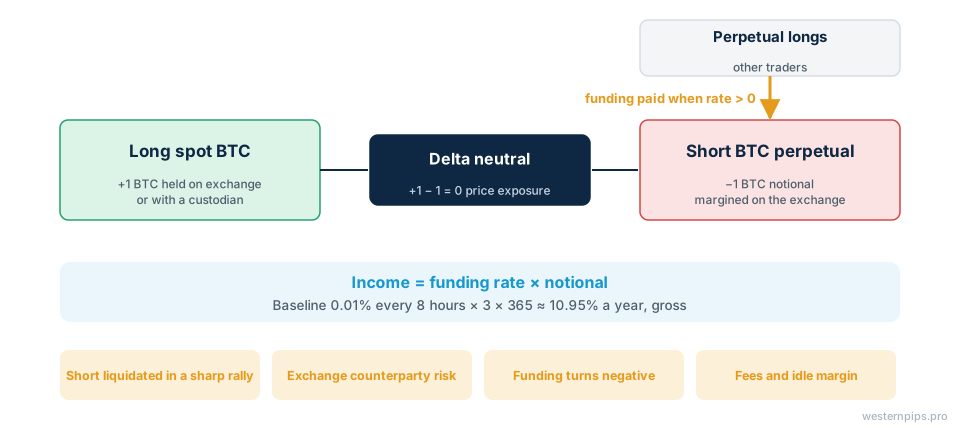
Figure 1: The cash-and-carry funding trade
Calculating real returns
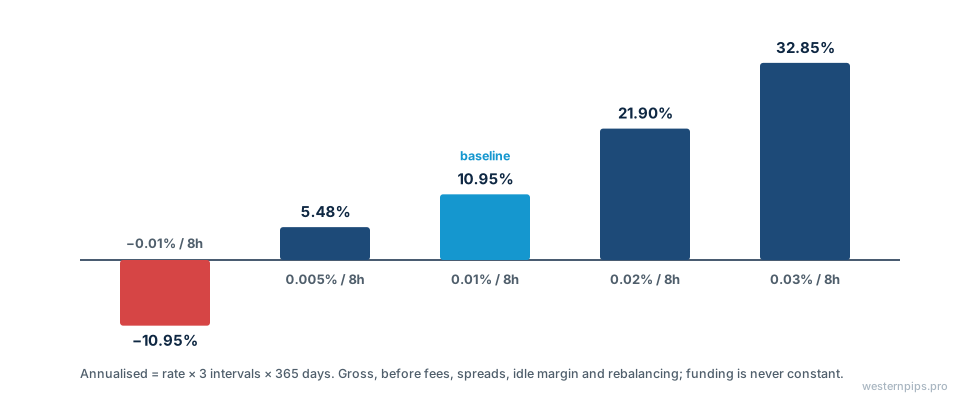
At the baseline 0.01% every 8 hours, gross funding is 0.01% × 3 × 365 ≈ 10.95% a year on the short notional. Net returns are lower once you include trading fees, the spread paid on entry and exit, idle margin collateral and any borrowing costs — and funding is never constant.
A worked example on $1,000,000 notional:
| Item | Assumption | Annual impact |
|---|---|---|
| Gross funding | 0.01% per 8h, all year | +$109,500 |
| Entry and exit fees | 4 legs × 0.02% | −$800 |
| Rebalancing | Monthly, 0.02% per leg | −$4,800 |
| Idle margin | 30% of notional earning nothing | Return on total capital falls |
| Net on deployed capital | Spot + margin ≈ $1.3m | ≈ 8% before taxes |
The example is illustrative. In strong bull markets funding can be several times the baseline; in sell-offs it can turn negative for days. Average 2025 funding on major contracts was well below 2024 levels according to several analyses, and yields on funding-based products ranged roughly from mid-single digits to the mid-teens over the year.
Figure 2: Funding per 8 hours, annualised
Who runs this trade at scale
Funding carry is a core strategy for crypto hedge funds, market makers and proprietary desks, and it underpins synthetic-dollar products such as Ethena’s USDe, which hedges staked collateral with short perpetuals. When funding weakens, such products shift reserves toward stablecoins and short-term government debt.
Large participants change the market: when many funds run the same carry, they compress funding and the premium. That is why funding has trended lower as institutional capital entered crypto derivatives — and why returns depend on timing and execution, not just the formula.
Capital efficiency and margin
Capital efficiency determines whether funding arbitrage beats simpler alternatives such as treasury bills. Key levers are using the spot asset as collateral for the short (portfolio or cross-margin), avoiding idle cash on multiple exchanges and keeping enough buffer to survive price spikes without liquidation.
- Isolated margin is simple but ties up extra collateral.
- Cross or portfolio margin lets the spot position offset the short, freeing capital — but concentrates risk on one exchange.
- Leverage on the short raises returns on capital and the risk of liquidation in a sharp rally.
- Off-exchange settlement and custody solutions let institutions reduce how much collateral sits on exchanges.
Risks institutions price in
The price risk is hedged; the other risks are not. Exchange insolvency or frozen withdrawals, liquidation or auto-deleveraging of the short leg, negative funding, basis moves on unwind, stablecoin depegs and operational errors are where funding arbitrage loses money.
| Risk | What happens | Mitigation |
|---|---|---|
| Exchange counterparty | Exchange fails or halts withdrawals | Diversify venues, off-exchange custody |
| Liquidation / ADL | Short leg closed in a spike, hedge breaks | Low leverage, margin buffers |
| Funding flips negative | Shorts start paying longs | Monitor regimes, exit rules |
| Basis risk | Perp-spot gap widens on exit | Unwind gradually |
| Stablecoin risk | Margin stablecoin depegs | Choose collateral carefully |
| Fees and slippage | Erode thin carry | Fee tiers, maker execution |
The October 2025 crypto crash is a case study: funding turned negative, liquidations cascaded and some exchanges auto-deleveraged profitable positions. Delta-neutral books survived only where margin buffers and venue diversification were adequate.
Funding arbitrage versus other arbitrage strategies
Funding arbitrage is a carry trade, not a speed trade. Unlike latency or triangular arbitrage, it does not require microsecond infrastructure; returns come from holding positions over days or weeks. That makes it accessible but crowded, so edge comes from capital efficiency, venue selection and risk control.
| Strategy | Source of return | Holding period | Infrastructure |
|---|---|---|---|
| Funding rate arbitrage | Funding payments | Days to months | Moderate |
| Basis (dated futures) | Convergence at expiry | Until expiry | Moderate |
| Latency arbitrage | Stale quotes | Microseconds | Very high |
| Cross-exchange spot arbitrage | Price gaps between venues | Seconds to minutes | High |
Frequently asked questions
What is funding rate arbitrage?
Funding rate arbitrage is a delta-neutral crypto strategy: you buy an asset in the spot market and short the same amount in perpetual futures (or the reverse). Price moves offset each other, and you earn the periodic funding payments that longs pay shorts when perpetuals trade above spot.
How is the funding rate calculated?
On major exchanges such as Binance, the funding rate equals the average premium index plus the difference between a fixed interest rate and that premium, clamped within a band (typically ±0.05%). With a default interest rate of 0.01% per 8-hour interval, funding stays at 0.01% whenever the premium is small.
How much can funding rate arbitrage earn?
At the baseline 0.01% every 8 hours, gross funding is about 11% a year on the notional of the short. Net returns are lower after trading fees, borrowing and margin requirements, and they vary sharply: funding can spike in bull markets and turn negative in sell-offs.
Is funding rate arbitrage risk-free?
No. Main risks include exchange insolvency or withdrawal freezes, liquidation or auto-deleveraging of the short leg during price spikes, funding turning negative, basis moves when unwinding, stablecoin depegs and fees.
What is the difference between funding rate arbitrage and basis trading?
Basis trading captures the price difference between spot and dated futures, which converges at expiry. Funding rate arbitrage uses perpetual futures, which never expire, and earns the funding payments that keep perpetual prices near spot.
Sources and further reading
- Introduction to Binance Futures funding rates — Binance
- Funding Rate Arbitrage: live scanner and strategy guide — BJF Trading Group, 2026
- Perpetual futures funding rates: 78% of a quarter at 0.01% — Coincub
- Ethena’s synthetic dollar token — Wharton Stevens Center
- funding-rate-arbitrage (open-source library) — GitHub — aoki-h-jp

Svetlana Berezhnova is a co-founder of Westernpips and has been a trader since 2007. She has been with the company from its very beginning and is an expert in high-frequency trading and latency-sensitive trading software.
This article is for educational purposes and describes market structure; it is not investment, legal or tax advice. Statistics are attributed to their original sources, which should be consulted for methodology and limitations.