
Key takeaways
- Payment for order flow is a per-share or per-contract payment a wholesale market maker makes to a broker for routing client orders to it.
- Market makers pay because retail flow is less informed than average, so filling it carries lower adverse selection risk.
- Retail clients usually receive price improvement versus the NBBO, but critics argue the routing conflict leaves money on the table compared with competitive auctions.
- Rule 606 shows where a US broker routes orders and what it is paid; expanded Rule 605 shows execution quality, with compliance from 1 August 2026.
- PFOF is legal in the US with disclosure; it is banned in the UK, Canada (for domestic listings) and, since June 2026, across the EU.
- In options, PFOF payments are larger per contract than in equities, making options the economic core of the model.
What is payment for order flow?
Payment for order flow (PFOF) is money a market maker pays a broker for routing client orders to it. The market maker executes the orders against its own inventory, earns part of the bid-ask spread and shares some of that with the broker. PFOF is what made commission-free retail trading economically viable in the US.
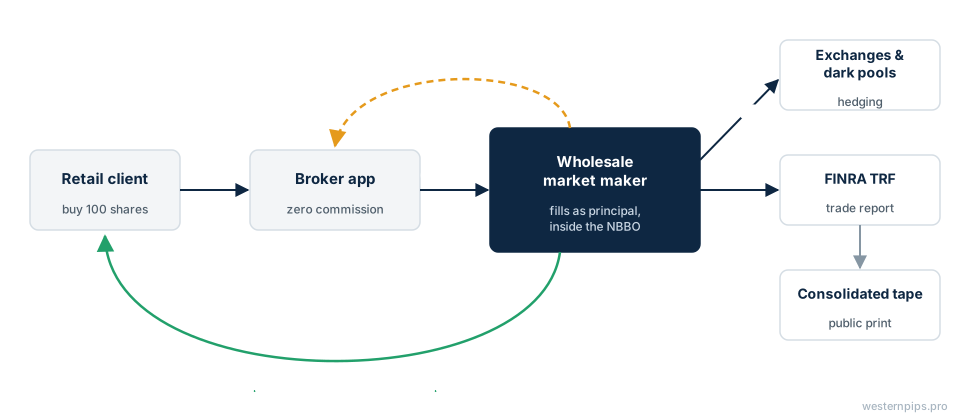
A typical flow looks like this: a retail client sends a market order to buy 100 shares through a broker app. Instead of sending it to an exchange, the broker routes it to a wholesale market maker. The wholesaler fills the order — usually slightly better than the best displayed price — and pays the broker a small fee per share or per options contract.
Three parties have something at stake:
- The client wants the best possible price.
- The broker earns PFOF instead of charging commissions.
- The wholesaler earns spread on low-risk flow.
The debate about PFOF is about whether these interests are aligned.
How a PFOF trade works, step by step
A retail order travels from the broker’s app to a wholesaler in milliseconds. The wholesaler checks the national best bid and offer, fills the order at or inside it, reports the trade to a FINRA trade reporting facility and later pays the broker a rebate based on the volume routed during the month.
- Order entry. A client places a market order to buy 100 shares. The displayed NBBO is $20.00 bid and $20.04 offer.
- Routing decision. The broker’s order router sends the order to one of several wholesalers it has agreements with, often based on execution-quality statistics and payment terms.
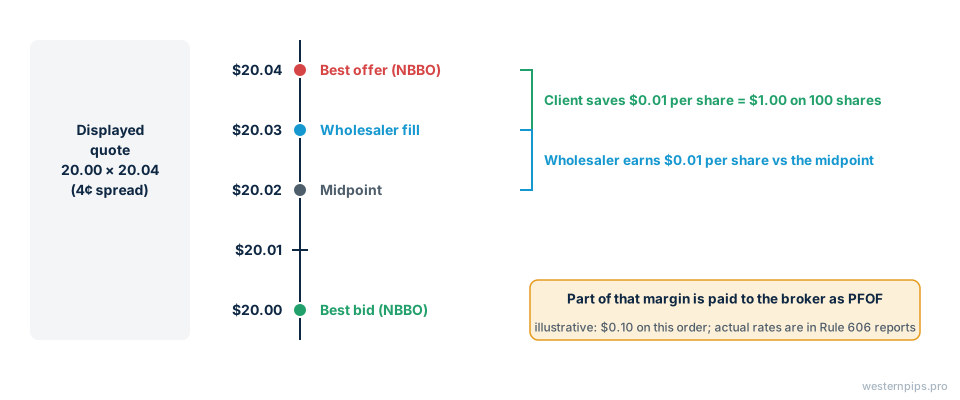
- Execution. The wholesaler fills the order as principal at, say, $20.03 — one cent of price improvement per share versus the $20.04 offer.
- Trade reporting. The trade prints off-exchange, reported to a FINRA trade reporting facility, and appears in consolidated data.
- Hedging. The wholesaler offsets its short position by internalising opposite retail orders or trading on exchanges and dark pools.
- Payment. At month end, the wholesaler pays the broker an agreed amount — for example a fraction of a cent per share on equities, more per options contract.
Figure 1: How a retail order is routed under PFOF
A brief history of PFOF
PFOF dates back to the 1980s, when Bernard Madoff’s market-making firm paid brokers about a cent per share for retail orders. Regulators allowed the practice with disclosure. Decimalisation, wholesaler consolidation and the zero-commission shift of 2019 then turned PFOF into the main revenue engine of US retail brokerage.
| Period | Development |
|---|---|
| 1980s | Off-exchange market makers begin paying brokers for retail flow |
| 1990s | The SEC adopts disclosure requirements for PFOF on trade confirmations and account statements |
| 2000–2001 | Rules 11Ac1-5 and 11Ac1-6 (later Rules 605 and 606) introduce execution-quality and routing reports; decimalisation narrows spreads |
| 2005 | Regulation NMS consolidates the rules and establishes the order protection framework |
| 2019 | Major US brokers cut commissions to zero, increasing reliance on PFOF |
| 2020 | The SEC charges a large retail broker with misleading customers about PFOF and best execution; the firm pays $65 million |
| 2021 | The meme-stock episode puts wholesaler concentration on the political agenda |
| 2024–2026 | EU ban adopted and fully effective; US Rule 605 expanded; order competition proposal withdrawn |
Madoff’s firm ran a legitimate and significant market-making business at the time; the investment fraud uncovered in 2008 was a separate operation. Today’s wholesalers built on the same idea at a much larger scale.
Why market makers pay for retail orders
Market makers pay for retail flow because it is less informed than average. Small orders from individual investors rarely predict short-term price moves, so filling them carries little adverse selection risk. That makes retail flow more profitable to trade against than anonymous exchange flow, which includes fast and informed traders.
On a lit exchange, a market maker’s quote is exposed to everyone — including latency arbitrageurs and institutions with information. It must widen its spread to cover those losses. When it can identify flow as retail, it can quote tighter, offer the client price improvement and still earn a margin.
This is the economic core of segmentation: separating benign flow from potentially toxic flow. PFOF is one way to price that segmentation; exchanges’ retail liquidity programmes and the EU’s systematic internalisers are others. The underlying theory — why spreads compensate for adverse selection — is covered in our market microstructure guide.
Where the money comes from: the PFOF economics
PFOF payments are small per order but large in aggregate. US brokers received billions of dollars a year in PFOF in the early 2020s, with options contributing more than equities. A handful of wholesalers handle most US retail equity market orders, which concentrates both the economics and the debate.
Figures reported in congressional research and industry press give a sense of scale: US brokers received roughly $2.5 billion in PFOF in 2020, and the largest brokers earned around $3.8 billion in 2021. At its peak, transaction-based revenue made up most of Robinhood’s net revenue, with options the largest share. The top three wholesalers have handled more than 80% of US retail equity market orders.
| Instrument | Typical PFOF level | Why |
|---|---|---|
| Equities | Fractions of a cent per share | Tight spreads, competitive wholesale market |
| Options | Cents per contract | Wider spreads, more complex pricing |
| Crypto (where offered) | Embedded in spread or venue rebates | Less regulated execution |
Because spreads in options are wider and retail options flow has grown sharply, options PFOF is where most of the money is. For the wholesalers themselves, retail flow is one business line inside much larger market-making operations.
Price improvement: benefit or illusion?
Wholesalers usually execute retail orders at prices better than the displayed national best bid or offer, and they report billions of dollars of price improvement a year. Critics respond that the NBBO is an artificially low benchmark and that open competition for orders would deliver more improvement than bilateral routing.
The case for PFOF rests on measurable price improvement. Industry advocates have cited figures of around $3.6 billion in price improvement in a single year based on Rule 605 data. Retail investors also benefit from zero commissions.
The case against focuses on three issues:
- Benchmark choice. The NBBO reflects round-lot quotes on exchanges; odd-lot and midpoint liquidity often offer better prices.
- Broker variation. Academic studies, including Schwarz, Barber, Huang, Jorion and Odean (2022), found large differences in execution costs for the same trades across brokers.
- Conflict of interest. A broker paid by a wholesaler has an incentive to route for payment, not price.
Figure 2: Price improvement versus the NBBO
What the research shows
The academic literature does not support either side’s simplest story:
- Execution differs across brokers. Schwarz and co-authors placed identical small trades through several US brokers at the same time and found meaningful differences in execution costs — evidence that routing arrangements matter.
- Routing incentives affect limit orders. Battalio, Corwin and Jennings (2016) found that some brokers routed non-marketable limit orders to venues paying the highest rebates, with worse fill rates for clients.
- Options are different. Studies of options PFOF suggest wider effective spreads and larger payments per contract than in equities, raising sharper questions about how much value reaches clients.
- Retail still benefits versus lit markets. Measured against the displayed NBBO, wholesaler executions are generally better than what a small marketable order would get on an exchange.
The practical conclusion is that PFOF is neither a scam nor a free lunch. Execution quality depends on the specific broker, the wholesalers it routes to and the order type.
Best execution: the legal duty behind PFOF
US brokers that accept PFOF must still seek the best reasonably available terms for client orders. FINRA Rule 5310 requires “regular and rigorous” reviews of execution quality across venues. Payment received cannot override that duty, and brokers must disclose the arrangement and route only where execution quality justifies it.
Best execution in the US is principles-based rather than a single rule about price. Brokers consider price, speed, likelihood of execution, order size and market conditions. In practice, compliance teams compare execution statistics across wholesalers and exchanges each quarter, adjust routing tables and document the reasons.
The 2020 SEC enforcement action against a major retail broker shows the limit of the model: the firm was found to have accepted unusually high PFOF while providing inferior execution prices for many orders and to have misled customers about its revenue sources. The case did not ban PFOF, but it made clear that payment and price improvement must be balanced.
Rule 605 and Rule 606: how to read the disclosures
Rule 606 reports show where a US broker routes orders and how much it is paid; Rule 605 reports show execution quality at each market centre, such as speed, price improvement and effective spread. Expanded Rule 605 reporting reached its compliance date on 1 August 2026, making cross-broker comparisons more meaningful.
- Rule 606 (brokers): quarterly reports listing the venues receiving non-directed orders and the net payments received per 100 shares or per contract.
- Rule 605 (market centres and, under the amendments, larger brokers): monthly statistics on execution quality by order type and size.
The 2024 amendments widened Rule 605’s scope to include larger broker-dealers and added standardised summary statistics. The SEC extended the compliance date from December 2025 to 1 August 2026. For institutions evaluating counterparties, these reports are the starting point for any execution-quality review.
Reading a Rule 606 report in five steps
- Pick the section. Reports are split into S&P 500 stocks, other NMS stocks and options.
- Check the order mix. Each section shows the share of non-directed orders that were market orders, marketable limit orders, non-marketable limit orders and other orders.
- Find the top venues. The table lists the venues that received the most orders and the share each received by order type.
- Read the payments. For each venue you see net payment received — in total dollars and per 100 shares (or per contract for options). Negative numbers mean the broker paid the venue, which is common for orders taking liquidity on exchanges.
- Read the narrative. The material aspects section explains the terms of each arrangement, such as volume tiers or profit-sharing.
Key Rule 605 metrics
| Metric | What it tells you |
|---|---|
| Effective spread | What clients actually paid relative to the midpoint |
| Effective-over-quoted (E/Q) spread ratio | Below 100% means executions were better than the quoted spread |
| Price improvement rate and amount | Share of orders filled inside the NBBO and by how much |
| Execution speed | Time from order receipt to execution |
| Fill rate (limit orders) | How often resting orders were executed |
Compare the same order type and size bucket across brokers; aggregate averages can hide large differences.
PFOF in options versus equities
Options account for the majority of PFOF revenue for many retail brokers. Options spreads are wider, pricing depends on volatility models and retail options flow has grown rapidly, so wholesalers pay more per contract than per equity share. Options also route through exchange auction mechanisms that formalise the payment.
In options, PFOF often flows through exchange price improvement auctions and marketing-fee programmes rather than purely bilateral arrangements. A broker sends an order to an exchange auction with a designated market maker guaranteed to participate, and the payment is funded through exchange fees collected from market makers. The growth of short-dated options, including 0DTE contracts, has made retail options flow one of the most valuable order streams in US markets — see our guide to how market makers make money.
The regulatory debate in the United States
The SEC has repeatedly examined PFOF without banning it. In 2022 it proposed an “order competition rule” that would have forced many retail orders into competitive auctions; that proposal was later withdrawn. Today PFOF remains legal, governed by best-execution duties and disclosure.
Key US milestones:
- 2005: Regulation NMS establishes the order protection rule and NBBO framework.
- 2021: The meme-stock episode brings PFOF and wholesaler concentration into mainstream debate.
- 2022: The SEC proposes Rule 615, requiring qualified auctions for many retail orders.
- 2024: The SEC adopts expanded Rule 605 disclosure and Reg NMS tick-size changes.
- 2025: The order competition proposal is withdrawn under new SEC leadership.
- 2026: Expanded Rule 605 reporting goes live on 1 August; tick-size and access-fee reforms are due in November.
The tick-size reform matters for PFOF too. Half-penny ticks for tightly spread stocks narrow the displayed NBBO, which shrinks the room for price improvement and changes how wholesalers price retail flow.
PFOF around the world and the 2026 EU ban
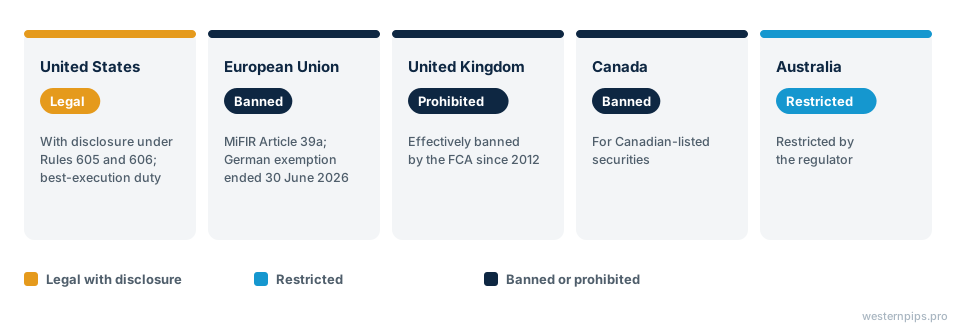
The UK has effectively prohibited PFOF since 2012, Canada bans it for domestic listings and Australia restricts it. The EU banned PFOF through the MiFIR review in 2024, with a transitional exemption used only by Germany; that exemption expired at the end of June 2026, completing the ban.
The EU ban is set out in Article 39a of MiFIR. When Germany’s grace period ended on 30 June 2026, neo-brokers that had relied on PFOF had to change their models. Reported responses include acting as principal on client trades, introducing small flat execution fees and pushing subscription plans. One major German neo-broker said the lost PFOF income was less than 30% of its revenue.
| Jurisdiction | PFOF status (late 2026) |
|---|---|
| United States | Legal, with Rule 605/606 disclosure |
| European Union | Banned (MiFIR Art. 39a), fully effective July 2026 |
| United Kingdom | Effectively prohibited by the FCA |
| Canada | Banned for Canadian-listed securities |
| Australia | Restricted |
Europe’s experience will be the most useful natural experiment of the next few years. Two questions matter: whether retail execution costs rise once brokers can no longer be paid by market makers, and whether the new EU consolidated tape, live since September 2026, improves best-execution analysis enough to offset the change.
Figure 3: PFOF status by jurisdiction, late 2026
Alternatives to PFOF
Brokers without PFOF earn from flat commissions, subscriptions, interest on client cash, securities lending and foreign-exchange conversion fees. On the execution side, alternatives include exchange retail liquidity programmes, midpoint and auction mechanisms, and routing directly to lit venues. Each model moves the conflict of interest rather than removing it.
| Model | How the broker earns | Trade-off for clients |
|---|---|---|
| Flat commission | Fixed fee per trade | Transparent but visible cost |
| Subscription | Monthly fee for unlimited trades | Good for active traders |
| Principal execution | Broker trades against the client | Conflict shifts from routing to pricing |
| Exchange retail programmes | Retail orders receive priority at improved prices on exchanges | Keeps retail flow on lit venues |
| Auctions and midpoint matching | Orders exposed to competing liquidity providers | Potentially more price improvement, more complexity |
What PFOF means for market structure
PFOF moves a large share of retail volume off exchanges and into wholesalers, which reduces the uninformed flow available on lit venues. That can widen displayed spreads for everyone else. Supporters counter that segmentation lowers costs for retail investors without harming institutions materially.
For institutional desks, the practical implications are:
- Lit-market quality: less retail flow on exchanges means a higher share of informed flow, which can widen displayed spreads.
- Off-exchange share: a large fraction of US equity volume executes away from exchanges, through wholesalers and dark pools.
- Venue design: exchanges compete for retail flow with retail priority programmes and midpoint liquidity.
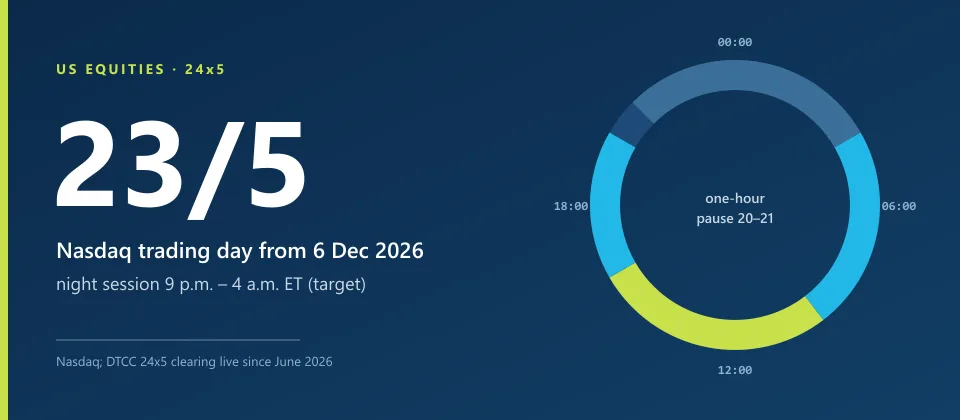
- 24-hour trading: overnight sessions on alternative venues and, from December 2026, on Nasdaq create new routing choices for retail flow — see our 24-hour trading analysis.
- Europe after the ban: watch whether execution moves back to lit venues and systematic internalisers, and how the new EU consolidated tape changes best-execution analysis.
A checklist for institutional readers
- Review Rule 606 reports of brokers you use for retail-facing or wealth-management flow.
- Use Rule 605 E/Q ratios and price improvement by order size, not headline averages.
- Track how off-exchange share and lit spreads in your names change after the November 2026 tick-size reform.
- In Europe, compare execution venues using EU consolidated tape data rather than single-venue benchmarks.
Frequently asked questions
What does payment for order flow mean?
Payment for order flow (PFOF) is compensation a broker receives from a market maker for sending it customer orders to execute. The market maker profits from the bid-ask spread on those orders and shares part of that profit with the broker.
Is payment for order flow legal?
In the United States it is legal, subject to best-execution obligations and disclosure under SEC Rules 605 and 606. It is effectively prohibited in the UK, banned for Canadian-listed securities and, after Germany’s transitional exemption expired at the end of June 2026, banned across the European Union.
Does PFOF cost retail investors money?
The evidence is mixed. Retail orders routed to wholesalers usually execute at better prices than the displayed NBBO, but studies have found large differences in execution quality between brokers, and critics argue competitive auctions would deliver more price improvement.
Why do market makers pay for retail orders?
Retail orders are typically small and uninformed, so market makers rarely lose money filling them. Avoiding adverse selection is valuable enough that they can offer price improvement to the client and still pay the broker.
How can I check whether my broker receives PFOF?
Look up the broker’s quarterly Rule 606 report, usually linked from its website footer or disclosures page. It lists the venues receiving non-directed orders and the net payment received per 100 shares for equities or per contract for options, broken down by order type.
Who invented payment for order flow?
The practice is usually traced to Bernard Madoff’s market-making firm in the 1980s, which paid brokers about a cent per share for retail orders. It was legitimate business at the time, unrelated to the fraud uncovered in 2008, and the model was later adopted by today’s wholesalers.
Which brokers do not use payment for order flow?
Some US brokers do not accept PFOF for equity orders and route to exchanges instead, and brokers operating in the EU and UK cannot accept it. Every US broker must disclose its routing and payments in quarterly Rule 606 reports, which are the reliable way to check.
Sources and further reading
- Payment for order flow — Wikipedia (regulatory history and references), 2026
- EU: MiFIR Amendments prohibiting PFOF entered into force on 28 March 2024 — HLC, 2024
- Trade Republic rebuilds trade execution as EU PFOF ban takes hold — Finance Magnates, 2026
- Federal Register notice: Rule 605 exemptions and compliance date — U.S. Securities and Exchange Commission, 2026
- SEC charges Robinhood for misleading customers about revenue sources and failing to satisfy duty of best execution — U.S. Securities and Exchange Commission, 2020
- FINRA Rule 5310: Best Execution and Interpositioning — FINRA, 2024
- Breaking Down the Payment for Order Flow Debate — a16z, 2021

Svetlana Berezhnova is a co-founder of Westernpips and has been a trader since 2007. She has been with the company from its very beginning and is an expert in high-frequency trading and latency-sensitive trading software.
This article is for educational purposes and describes market structure; it is not investment, legal or tax advice. Statistics are attributed to their original sources, which should be consulted for methodology and limitations.