Key takeaways
- Time series foundation models (TSFMs) are large models pre-trained on huge collections of time series that can forecast new series zero-shot, without task-specific training.
- Leading open models include Amazon’s Chronos-2, Google’s TimesFM, Salesforce’s Moirai, Datadog’s Toto and CMU’s MOMENT; Chronos-2 led major public benchmarks in late 2025.
- On raw stock returns, evidence is weak: one study found negative out-of-sample R² and directional accuracy barely above 51% for Chronos and TimesFM.
- TSFMs are more useful for volatility, volume, liquidity and risk forecasting, anomaly detection and as fast baselines than for predicting prices.
- Watch for data leakage from pre-training, non-stationarity, inference latency and licences that restrict commercial use.
What are time series foundation models?
Time series foundation models (TSFMs) are large neural networks pre-trained on huge collections of time series so they can forecast new series without task-specific training. Like language models for text, they learn general patterns — trend, seasonality, regime shifts — and apply them zero-shot to data they have never seen.
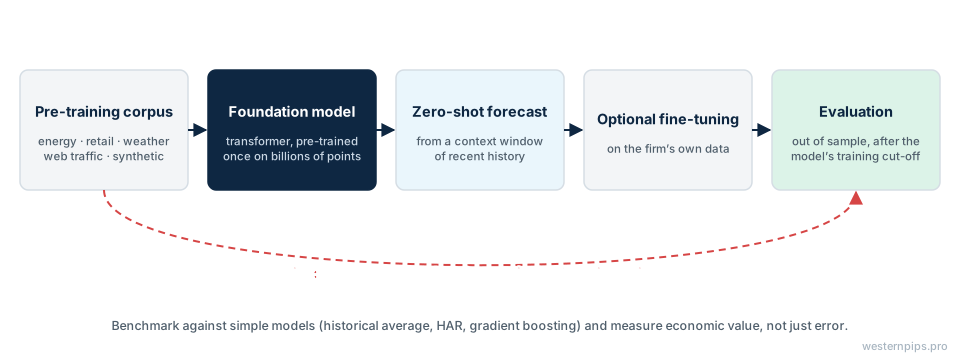
Traditional forecasting fits a separate model to each series: ARIMA for one, gradient boosting for another. TSFMs flip that approach. A single model, trained on billions of observations from energy, retail, weather, web traffic and more, produces forecasts directly from a context window of recent history.
For trading firms, the appeal is obvious: instant baselines for thousands of instruments, no per-series tuning and probabilistic forecasts out of the box. The question is whether those forecasts carry any edge in markets.
The leading models in 2026
The main open models are Amazon’s Chronos family (Chronos-2 released in late 2025), Google’s TimesFM (TimesFM-2.5 and newer releases), Salesforce’s Moirai, Datadog’s Toto, CMU’s MOMENT, Lag-Llama and IBM’s Tiny Time Mixers. Nixtla’s TimeGPT is a commercial API model.
| Model | Developer | Notable features | Licence (check before use) |
|---|---|---|---|
| Chronos-2 | Amazon | Univariate, multivariate and covariate forecasting; led GIFT-Eval in late 2025 | Permissive (reported Apache 2.0) |
| TimesFM-2.5 | Decoder-only, long context; in-context fine-tuning research | Varies by version | |
| Moirai 2.0 | Salesforce | Multivariate, trained on large LOTSA corpus | Reported non-commercial |
| Toto | Datadog | Built for observability metrics | Reported Apache 2.0 |
| MOMENT | CMU Auton Lab | Forecasting, classification, anomaly detection, imputation | MIT |
| TimeGPT | Nixtla | Commercial API, trained on 100bn+ data points | Commercial |
How they perform on general benchmarks
On public benchmarks such as GIFT-Eval and fev-bench, Chronos-2 ranked first in late 2025, ahead of TiRex, TimesFM-2.5, Toto and Moirai 2.0. Google reported that in-context fine-tuning made TimesFM about 6.8% more accurate than its base version across 23 unseen datasets.
These benchmarks matter, but they are dominated by non-financial data — electricity load, traffic, retail demand — where seasonality and stable structure make forecasting easier. Strong benchmark scores tell you a model is a good general forecaster, not that it will predict markets.
What the evidence says about financial data
On equity returns, TSFMs show little predictive power. One study found Chronos and TimesFM produced negative out-of-sample R² on excess returns, around −1.4% and −2.8%, with directional accuracy only slightly above 51%. Results on volatility and other more persistent quantities are more encouraging.
Why returns are so hard:
- Low signal-to-noise: most short-term price variation is noise.
- Adaptation: any predictable pattern is traded away as others discover it — alpha decay.
- Non-stationarity: regimes change with policy, liquidity and market structure.
- No seasonality to exploit: unlike electricity demand, prices have no reliable daily cycle.
Quantities with more persistence — realized volatility, trading volume, spreads, order book depth — are better candidates. Researchers began benchmarking TSFMs against econometric volatility models such as HAR in 2026.
Practical use cases for trading desks
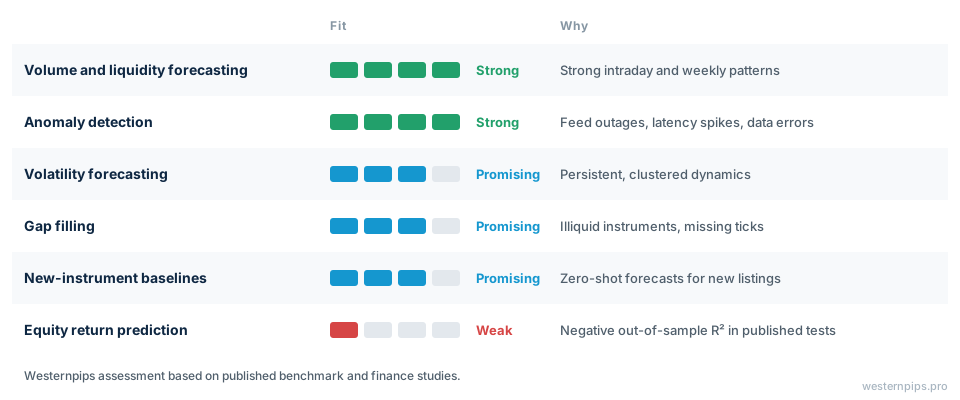
TSFMs are most useful where structure is stable: forecasting volatility, volume and liquidity for execution scheduling, filling gaps in data, detecting anomalies in market data or system metrics, producing quick baselines for new instruments and supporting risk and capacity planning.
| Use case | Why TSFMs fit | Example |
|---|---|---|
| Volume and liquidity forecasting | Strong intraday and weekly patterns | Scheduling VWAP child orders |
| Volatility forecasting | Persistent, clustered dynamics | Risk limits, option pricing inputs |
| Anomaly detection | Learned “normal” behaviour | Feed outages, latency spikes, data errors |
| Gap filling | Probabilistic imputation | Illiquid instruments, missing ticks |
| New instrument baselines | Zero-shot forecasts | Recently listed assets |
| Infrastructure planning | Classic time series problem | Message rates, capacity |
Figure 1: Where TSFMs fit on a trading desk
Pitfalls: leakage, latency and licences
The main risks are data leakage — pre-training corpora may include the very financial series you test on — plus non-stationarity, inference latency too slow for fast strategies and licences that restrict commercial use. Rigorous out-of-sample testing on data after each model’s training cut-off is essential.
A checklist before deploying a TSFM:
- Check the training cut-off and corpus and test only on data the model could not have seen.
- Benchmark against simple models — historical averages, HAR, gradient boosting — not just other TSFMs.
- Measure economic value, not just forecast error: does the forecast improve execution cost or risk?
- Measure inference latency on your hardware; most TSFMs are far too slow for the HFT critical path.
- Review the licence for commercial and trading use.
- Monitor drift and re-evaluate regularly.
Figure 2: Building, using and evaluating a TSFM
Where TSFMs fit in a quant stack
TSFMs are best seen as a strong general-purpose layer: fast baselines, features and risk forecasts that feed specialised models. Alpha in returns still comes from proprietary data, microstructure features and domain-specific models; foundation models make the surrounding infrastructure faster and more robust.
A pragmatic architecture:
- Use TSFM forecasts of volatility and volume as features in proprietary models.
- Use them as baselines that new research must beat.
- Use them for monitoring — anomaly detection on market data and system metrics.
- Keep latency-critical decisions in compact models or hardware, informed by slower TSFM outputs.
Frequently asked questions
What is a time series foundation model?
A time series foundation model is a large neural network, usually transformer-based, pre-trained on billions of observations from many domains. It can forecast series it has never seen (zero-shot) and can be fine-tuned for specific tasks.
Can time series foundation models predict stock prices?
Not reliably. Published tests on equity returns show little or no predictive power out of sample — negative R² and directional accuracy close to a coin flip. Financial returns are noisy and adapt as markets learn, which limits any generic forecaster.
Which time series foundation model is best?
On public benchmarks such as GIFT-Eval and fev-bench, Amazon’s Chronos-2 led in late 2025, ahead of TiRex, TimesFM-2.5 and Toto. Benchmarks use mostly non-financial data, so firms should test models on their own data and tasks.
Are time series foundation models open source?
Several are open-weight: Chronos-2 and MOMENT are released under permissive licences, while some others carry non-commercial or research-only terms. Always check the licence before using a model in a trading system.
Where do time series foundation models help in trading?
They are most useful for forecasting volatility, volume and liquidity, filling gaps in data, detecting anomalies, generating quick baselines for new instruments and supporting risk and capacity planning — tasks with more stable structure than returns.
Sources and further reading
- Chronos-2: From Univariate to Universal Forecasting (arXiv 2510.15821) — Amazon / arXiv, 2025
- Time series foundation models can be few-shot learners — Google Research, 2025
- Foundation Models for Time Series: A Survey (arXiv 2504.04011) — arXiv, 2025
- MOMENT: A family of open time-series foundation models — CMU Auton Lab / GitHub, 2024
- Forecasting: Principles and Practice (Python edition), chapter 15 — foundation models — OTexts
- Forecasting realized volatility with time series foundation models (arXiv 2607.05291) — arXiv, 2026

Svetlana Berezhnova is a co-founder of Westernpips and has been a trader since 2007. She has been with the company from its very beginning and is an expert in high-frequency trading and latency-sensitive trading software.
This article is for educational purposes and describes market structure; it is not investment, legal or tax advice. Statistics are attributed to their original sources, which should be consulted for methodology and limitations.